



 0
0
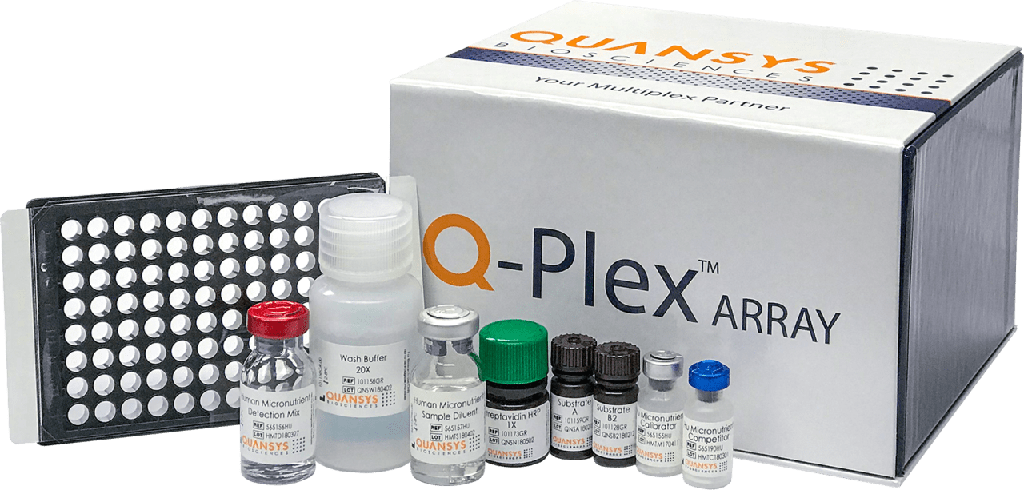
Q-Plex™ Human Environmental Enteric Dysfunction (11-Plex)
Catalog No :
CAS Number :
Brand :
In Stock
For measurement of AGP, CD-14, CRP, Ferritin, FGF-21, HRP2, IFABP, IGF-1, RBP4, sTfR, Thyroglobulin
Specifications:
| Application | Protein Assays & Analysis | ||
| Storage Temperature | 2-8°C | ||
| Product Type | Assay Kits | Forms | Kit with Various components |
| Product Brand | QUANSYS Biosciences | ||
| Product Grade | Molecular Biology | ||
The Q-Plex Human Environmental Enteric Dysfunction (11-Plex) is a fully quantitative, planar multiplex chemiluminescent immunoassay designed for simultaneous measurement of eleven biomarkers associated with Environmental Enteric Dysfunction (EED), nutrition, systemic inflammation, intestinal integrity, growth, and malaria status.
Developed in collaboration with PATH, this multiplex array enables researchers to generate a comprehensive nutritional and inflammatory biomarker profile using only 5 µL of serum or heparin plasma per well. The assay is optimized for high-throughput testing, delivering quantitative results within 3.5 hours with <1% cross-reactivity and no significant observed interference.
Background – Environmental Enteric Dysfunction (EED)
Environmental Enteric Dysfunction is characterized by chronic intestinal inflammation, compromised mucosal barrier function, and impaired nutrient absorption. It is highly prevalent in low-resource settings with high enteric pathogen exposure and inadequate sanitation. EED is associated with:
- Stunted growth
- Impaired cognitive development
- Reduced vaccine responsiveness
- Increased susceptibility to infections such as pneumonia, diarrhea, and malaria
The Q-Plex EED (11-Plex) panel provides an integrated biomarker solution to support population health research, clinical studies, and global health programs focused on malnutrition and childhood disease risk.
Target Analytes and Clinical Relevance
Growth and Vaccine Response
- Intestinal Fatty Acid Binding Protein (I-FABP) – Marker of small intestine damage
- Soluble CD14 (sCD14) – White blood cell activation
- Insulin-like Growth Factor 1 (IGF-1) – Bone and tissue growth
- Fibroblast Growth Factor 21 (FGF21) – Metabolic pathway modulation
Systemic Inflammation
- Alpha-1-acid Glycoprotein (AGP) – Inflammatory response
- C-reactive Protein (CRP) – Acute-phase inflammation
Nutritional Status
- Ferritin – Iron storage
- Soluble Transferrin Receptor (sTfR) – Iron deficiency
- Retinol Binding Protein 4 (RBP4) – Vitamin A transport
- Thyroglobulin (Tg) – Iodine nutritional status
Malaria Indicator
- Histidine-Rich Protein 2 (HRP2) – Presence of malaria infection
Assay Principle
The Q-Plex EED panel utilizes a planar multiplex array format in which capture antibodies are spatially immobilized at defined positions within each well. Both competitive and sandwich immunoassay formats are integrated within the same plate depending on the analyte.
Following sample incubation, detection reagents and Streptavidin-HRP enable chemiluminescent signal generation. Light emission is captured using Q-View imagers and analyzed with Q-View Software for fully quantitative reporting.
Cross-reactivity is <1% across analytes, ensuring reliable multiplex performance.
Performance and Validation Data
| Analyte | Assay Type | Calibrator Range | ULOQ | LLOQ | LOD | Inter-Assay CV | Intra-Assay CV | Avg. Linearity |
|---|---|---|---|---|---|---|---|---|
| AGP | Competitive | 0.36 – 0.00049 g/L | 0.25 g/L | 0.0019 g/L | 0.00025 g/L | 12% | 5% | 107% |
| CD-14 | Competitive | 1,750 – 2.4 ng/mL | 1,225 ng/mL | 9.4 ng/mL | 1.2 ng/mL | 11% | 6% | 93% |
| CRP | Competitive | 5.61 – 0.0077 mg/L | 3.93 mg/L | 0.03 mg/L | 0.0038 mg/L | 14% | 5% | 95% |
| Ferritin | Sandwich | 115 – 0.16 µg/L | 80.5 µg/L | 0.21 µg/L | 0.079 µg/L | 12% | 8% | 102% |
| FGF-21 | Sandwich | 800 – 1.10 pg/mL | 560 pg/mL | 1.40 pg/mL | 0.55 pg/mL | 12% | 6% | 100% |
| HRP2 | Sandwich | 0.96 – 0.0013 µg/L | 0.67 µg/L | 0.0017 µg/L | 0.00066 µg/L | 13% | 4% | 100% |
| IFABP | Sandwich | 3,000 – 4.12 pg/mL | 2,100 pg/mL | 5.3 pg/mL | 2.06 pg/mL | 10% | 5% | 92% |
| IGF-1 | Sandwich | 198 – 0.27 ng/mL | 139 ng/mL | 0.35 ng/mL | 0.14 ng/mL | 13% | 9% | 118% |
| RBP4 | Competitive | 1.4 – 0.0019 µmol/L | 0.98 µmol/L | 0.0075 µmol/L | 0.0010 µmol/L | 11% | 8% | 93% |
| sTfR | Sandwich | 108 – 0.15 mg/L | 75.3 mg/L | 0.19 mg/L | 0.074 mg/L | 15% | 6% | 115% |
| Thyroglobulin | Sandwich | 13.7 – 0.019 µg/L | 9.59 µg/L | 0.024 µg/L | 0.0094 µg/L | 13% | 4% | 100% |
Cross-Reactivity and Interference: <1%; no significant interference observed.
Validated Sample Types
- Human Serum
- Human Heparin Plasma
Kit Contents
Each kit includes:
- 96-well multiplex plate pre-coated with 11 biomarkers
- Calibrator standards
- Competitor reagents (for competitive assays)
- Detection mix
- Streptavidin-HRP
- Chemiluminescent substrates
- Sample diluents
- Wash buffer
- Instruction manual
Required Instrumentation
All Q-Plex multiplex assays require compatible Q-View imagers for signal detection and Q-View software for data analysis. Performance with non-compatible imaging systems is not guaranteed.
Applications
- Environmental Enteric Dysfunction research
- Child growth and nutrition studies
- Vaccine response investigations
- Global health and public health surveillance
- Malaria epidemiology studies
- Micronutrient deficiency research
- Population-level biomarker screening
The Q-Plex Human EED (11-Plex) panel provides an integrated, small-volume, high-sensitivity multiplex solution for simultaneous assessment of inflammation, nutrition, intestinal damage, growth markers, and malaria exposure. The planar multiplex design eliminates bead-based complexity while maintaining robust precision and minimal cross-reactivity.