



 0
0
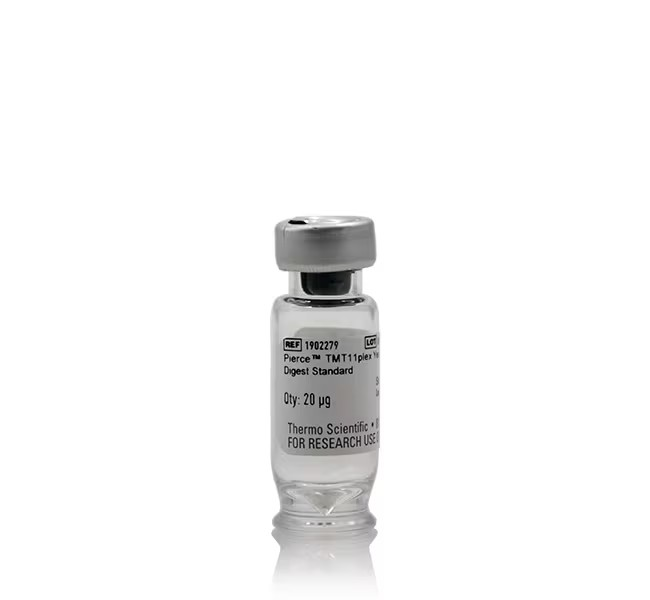
Thermo Scientific™ Pierce™ TMT11plex Yeast Digest Standard
Catalog No :
CAS Number :
Brand :
In Stock
Specifications:
| Application | Mass Spectrometry | ||
| Storage Temperature | 2-8°C | ||
| Product Type | Standards | Forms | lyophilized powder |
| Product Brand | Thermo Fisher Scientific™ | ||
| Product Grade | Analytical grade | ||
The Thermo Scientific™ Pierce™ TMT11plex Yeast Digest Standard is a high-quality, ready-to-use quantitative proteomics standard designed to evaluate and optimize LC-MS/MS performance in isobaric labeling workflows. This standard is prepared from four Saccharomyces cerevisiae strains, including the parental strain BY4741 and three knockout strains (ΔMet6, ΔHis4, ΔUra2). Each strain is digested, labeled with TMT11plex isobaric reagents, and mixed in defined ratios to enable precise and reproducible analysis across all 11 reporter channels.
Purpose-built for comprehensive system suitability testing, the TMT11plex Yeast Digest Standard allows scientists to monitor channel precision, quantify peptide abundance, detect ion interference, and validate the overall performance of TMT-based proteomics workflows. It is widely used in laboratories performing multiplexed quantitative proteomics on Orbitrap and other high-performance LC-MS/MS systems.
Key Benefits
Multichannel Quantitation Monitoring
Supports the evaluation of all 11 TMT reporter channels, ensuring signal consistency, accurate peak integration, and strong labeling performance.
Reliable System Suitability Testing
Ideal for verifying instrument readiness, optimizing LC-MS/MS methods, and assessing quantitative robustness for TMT analyses.
High-Quality, Ready-to-Use Format
Supplied as lyophilized powder pre-labeled with TMT11plex reagents, allowing quick reconstitution and direct injection.
Optimized for Method Development
Facilitates optimization of chromatography, collision energies, MS2/MS3 acquisition settings, fractionation, and data processing workflows.
Scientifically Validated
Prepared from verified yeast strains, mixed equimolarly, and aligned with published proteomics quality control methodologies.
Available Formats
| Catalog Number | Quantity | Format |
|---|---|---|
| A40938 | 20 μg | Single vial |
| A40939 | 5 × 20 μg | Pack of five vials |
Technical Specifications
| Parameter | Description |
|---|---|
| Product Type | Digest Standard |
| Final Product Type | MS Standard |
| Detection Method | Mass Spectrometry (LC-MS/MS) |
| Form | Lyophilized Powder |
| Starting Material | Tryptic Peptides |
| Workflow Step | MS System Performance and QC |
| For Use With | Mass Spectrometers |
| Shipping Condition | Wet Ice |
| Unit Size | Each |
Applications
- Monitoring TMT11plex quantitation performance
- System suitability testing for LC-MS/MS instruments
- Optimization of HCD and MS2/MS3 acquisition methods
- Detection and diagnosis of ion interference and ratio compression
- Benchmarking of new instrument configurations
- Quality control for high-throughput TMT-based proteomics workflows
Key References
- Paulo JA, O'Connell JD, Gygi SP. A Triple Knockout (TKO) Proteomics Standard for Diagnosing Ion Interference in Isobaric Labeling Experiments. J Am Soc Mass Spectrom. 2016.
- Yang F, Shen Y, Camp DG, Smith RD. High-pH reversed-phase chromatography with fraction concatenation for 2D proteomic analysis. Expert Rev Proteomics. 2012.
- Dayon L, Pasquarello C, Hoogland C, Sanchez JC, Scherl A. Combining low- and high-energy tandem MS spectra for optimized peptide quantification with isobaric tags. J Proteomics. 2010.
- Diedrich JK, Pinto AF, Yates JR. Energy dependence of HCD on peptide fragmentation. J Am Soc Mass Spectrom. 2013.
- Chiva C, Sabidó E. HCD-only fragmentation method balances peptide identification and quantitation of TMT-labeled samples. J Proteomics. 2014.
The Thermo Scientific™ Pierce™ TMT11plex Yeast Digest Standard is an essential tool for any laboratory performing multiplexed quantitative proteomics. By providing a reliable and well-characterized benchmark for TMT-based workflows, it enables researchers to confidently assess system performance, optimize acquisition methods, and maintain high analytical standards across experiments. Its ready-to-use format, robust design, and proven reproducibility make it indispensable for method development, instrument validation, and long-term quality control in modern proteomics laboratories.
- Pack Size: 1 x 20 μg 5 x 20 μg