



 0
0
Specifications:
| Application | Nursing Skills, Skills Training |
| Storage Temperature | Ambient |
| Product Type | Anatomical Model |
| Product Brand | General Doctor |
| Product Grade | Anatomical grade |
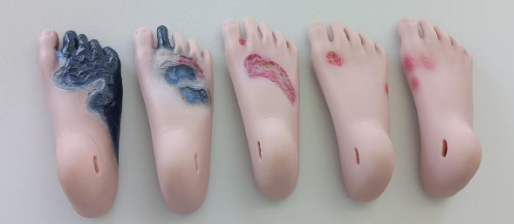
The GD/HS19.100 Advanced Diabetic Foot Care Model is a comprehensive clinical training tool designed to simulate the progressive stages of diabetic foot complications, from early superficial ulcers to severe necrosis requiring amputation. This model is ideal for nursing education, wound care training, and clinical skills development, enabling healthcare professionals to accurately assess, classify, and manage diabetic foot conditions.
Engineered to represent five clinically relevant grades of diabetic foot pathology, the model provides a realistic platform for understanding disease progression, infection severity, and appropriate treatment interventions. It can be seamlessly mounted onto compatible nursing simulation manikins, allowing integration into full-patient care scenarios.
Key Features
-
Multi-Stage Disease Simulation (Grade 1–5)
Accurately replicates the full progression of diabetic foot complications, supporting both basic and advanced clinical training. -
Highly Realistic Pathological Representation
Includes detailed visualization of ulcers, abscesses, necrosis, gangrene, and tissue destruction for enhanced diagnostic learning. -
Wound Assessment & Classification Training
Enables users to practice identification and grading of diabetic foot lesions based on clinical presentation. -
Integrated Clinical Skills Training
Supports wound care procedures, infection management, debridement concepts, and clinical decision-making. -
Manikin Compatibility
Designed for attachment to nursing simulation manikins, facilitating holistic patient care training and scenario-based learning. -
Durable & Replaceable Design
Allows repeated use and easy replacement of modules for different training levels.
Clinical Grading Simulation
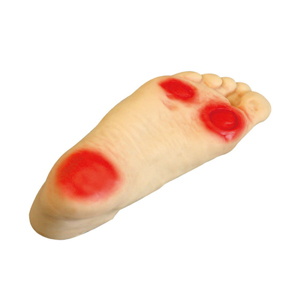
Grade 1 – Superficial Lesions
- Open lesions on acral skin
- Includes superficial ulcers from blisters, corns, calluses, burns, or frostbite
- No involvement of deep tissues
Grade 2 – Deep Tissue Infection
- Infection extends into muscle tissue
- Associated with cellulitis, multiple abscesses, and sinus formation
- Penetrating ulcers with purulent discharge
- Tendons and ligaments remain intact
Grade 3 – Advanced Soft Tissue Destruction
- Tendons and ligaments destroyed
- Large abscess cavities with necrotic tissue
- Increased purulent discharge
- No obvious bone destruction
Grade 4 – Bone Involvement & Gangrene
- Bone defects, osteomyelitis, and joint destruction
- Formation of false joints possible
- Severe wet or dry gangrene affecting digits or parts of the foot
Grade 5 – Extensive Necrosis
- Widespread infection or ischemia
- Severe necrosis with blackened, mummified tissue
- May involve ankle joint and lower leg
- Typically requires high-level surgical amputation
Applications
- Nursing and medical education programs
- Wound care and diabetic foot management training
- Clinical skills laboratories and simulation centers
- Surgical and podiatry training
- Patient assessment and case-based learning
Technical Specifications
| Parameter | Description |
|---|---|
| Product Name | Advanced Diabetic Foot Care Model |
| Model | GD/HS19.100 |
| Brand | General Doctor |
| Simulation Range | Grade 1 to Grade 5 diabetic foot conditions |
| Pathologies Simulated | Ulcers, abscesses, cellulitis, necrosis, gangrene, osteomyelitis |
| Training Focus | Assessment, classification, wound care, clinical decision-making |
| Compatibility | Mountable on nursing simulation manikins |
| Reusability | Replaceable modules for repeated training |
The GD/HS19.100 Advanced Diabetic Foot Care Model is a critical training solution for improving the diagnosis and management of diabetic foot complications. By offering realistic, progressive pathology simulation across all clinical grades, it equips healthcare professionals with the knowledge and practical skills needed to reduce complications, improve patient outcomes, and support timely clinical interventions. This model is an invaluable addition to institutions focused on wound care excellence, diabetes management, and advanced clinical training.