



 0
0
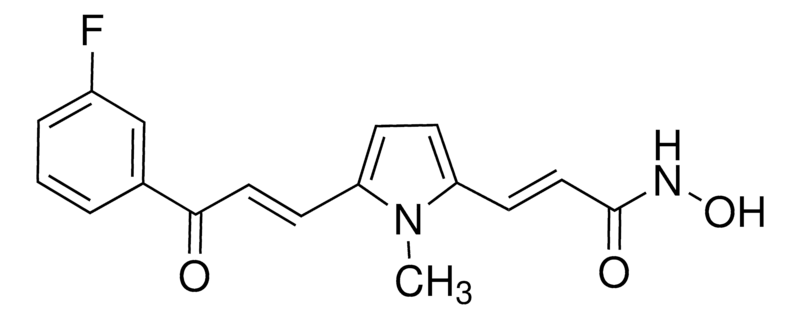
MC1568 99.51%
Catalog No :
CAS Number :
Brand :
In Stock
Selective Class IIa HDAC Inhibitor | Maize HD1-A Inhibitor
Specifications:
| Application | Protein Biology | ||
| Storage Temperature | -20°C | ||
| Product Type | Proteins & Peptides | Forms | Solid |
| Product Brand | Selleckchem | ||
| Product Grade | HPLC Grade | Formula | C17H15FN2O3 |
MC1568 is a selective histone deacetylase inhibitor with activity against class IIa HDACs and reported inhibitory activity against maize HD1-A. In cell-free assays, MC1568 inhibits maize HD1-A with an IC50 of 100 nM and shows approximately 34-fold selectivity for HD1-A over HD1-B.
MC1568 is widely used in epigenetics, differentiation, myogenesis, adipogenesis, transcriptional regulation, and HDAC signalling research. It has been studied in several cellular models, including breast cancer cells, myoblasts, embryonal carcinoma cells, adipocyte differentiation models, and mouse tissue-selective HDAC inhibition studies.
Key Features
- Selective HDAC inhibitor with class IIa HDAC activity
- Inhibits maize HD1-A with IC50 of 100 nM
- Approximately 34-fold selectivity for HD1-A over HD1-B
- Reported class II HDAC IC50 of 220 nM
- Demonstrates strong selectivity for class II HDACs over class I HDACs
- Inhibits HDAC4 activity in human breast cancer cell lysates
- Used to study myogenesis, adipogenesis, endodermal differentiation, and PPARγ signalling
- Suitable for epigenetics, chromatin regulation, differentiation, and transcriptional research
- Commonly prepared in DMSO for in vitro studies
- For research use only
Target Profile
| Target | Assay Type | Reported Activity |
|---|---|---|
| HD1-A, Maize | Cell-free assay | IC50 = 100 nM |
| HD1-B, Maize | Cell-free assay | IC50 = 3.4 µM |
| Class II HDACs | Cell-free assay | IC50 = 220 nM |
| Class I HDACs | Comparative selectivity | 176-fold lower sensitivity than class II |
Biological Activity
MC1568 has been studied as a selective class IIa HDAC inhibitor in both cell-free and cell-based models. In human breast cancer ZR-75.1 cell lysates, MC1568 at 5 µM showed no inhibitory activity against HDAC1 but inhibited HDAC4, supporting its class II HDAC selectivity.
In MCF-7 cells, MC1568 at 20 µM increased the accumulation of acetylated histone H3 and H4, as well as acetylated tubulin, indicating effects on histone acetylation and HDAC6-associated pathways.
In C2C12 myoblasts, MC1568 at 5 µM has been reported to arrest myogenesis by reducing MEF2D expression, stabilizing the HDAC4-HDAC3-MEF2D complex, and inhibiting differentiation-associated MEF2D acetylation.
In Vitro Research Applications
| Research Area | Typical Use |
|---|---|
| Epigenetics Research | Study of class IIa HDAC inhibition and histone acetylation |
| Chromatin Regulation | Investigation of HDAC-mediated transcriptional repression |
| Myogenesis Studies | Analysis of MEF2D regulation and muscle cell differentiation |
| Adipogenesis Research | Study of PPARγ-mediated adipocyte differentiation pathways |
| Cancer Cell Biology | Evaluation of HDAC4 and HDAC6-related effects in breast cancer models |
| Differentiation Research | Investigation of retinoic acid and PPARγ-related differentiation pathways |
| Signal Transduction | Study of transcription factor-HDAC complex regulation |
| Developmental Biology | Research into lineage differentiation and endocrine cell development |
Cell-Based Research Data
| Parameter | Details |
|---|---|
| Cell Lines / Models Studied | ZR-75.1, MCF-7, C2C12, F9, NB4, 3T3-L1 |
| Common Solvent | DMSO |
| Example Concentrations | 5 µM, 10 µM, 20 µM |
| 3T3-L1 Study Concentration | Approximately 10 µM |
| 3T3-L1 Incubation Time | 8 days |
| Example Readouts | Histone acetylation, acetyl-tubulin, MEF2D expression, adipogenesis, differentiation signalling |
HDAC Enzyme Inhibition Assay Summary
MC1568 has been evaluated in maize HDAC enzyme inhibition assays using a radiolabelled histone substrate method. The assay measures the release of tritiated acetic acid from prelabelled histones and quantifies activity by scintillation counting.
| Assay Parameter | Details |
|---|---|
| Enzymes Studied | Maize HD2, HD1-B, and HD1-A |
| Substrate | [³H]acetate-prelabelled chicken reticulocyte histones |
| Enzyme Incubation Temperature | 30°C |
| Incubation Time | 30 minutes |
| Detection Method | Liquid scintillation counting |
| Starting Test Concentration | 40 µM |
| Assay Output | IC50 determination |
| Controls / Comparators | NaB, VPA, TSA, SAHA, TPX, HC-toxin, tubacin, and solvent controls |
In Vivo Research Summary
MC1568 has been studied in mouse models for tissue-selective HDAC inhibition and transcriptional signalling research. In mice, MC1568 at 50 mg/kg has shown apparent tissue-selective HDAC inhibition, particularly in skeletal muscle and heart.
| Parameter | Details |
|---|---|
| Animal Model | PPRE-Luc transgenic mouse, C57BL/6 |
| Example Dose | 50 mg/kg |
| Administration Route | Oral gavage |
| Frequency | Once daily |
| Reported Research Effects | Tissue-selective HDAC4 and HDAC5 inhibition, PPARγ signalling modulation |
| Tissues Studied | Skeletal muscle, heart, adipose tissue |
| Additional Research Model | Pancreatic explants |
Research Findings Summary
| Observation | Research Relevance |
|---|---|
| Inhibits maize HD1-A | Useful for plant HDAC enzyme inhibition research |
| Selective for class II HDACs | Supports studies requiring reduced class I HDAC inhibition |
| Inhibits HDAC4 without HDAC1 inhibition in ZR-75.1 lysates | Useful for class IIa HDAC selectivity studies |
| Increases acetylated H3, H4, and acetyl-tubulin in MCF-7 cells | Supports histone and tubulin acetylation research |
| Stabilizes HDAC4-HDAC3-MEF2D complex in C2C12 cells | Useful for myogenesis and MEF2D signalling studies |
| Interferes with RAR- and PPARγ-mediated differentiation pathways | Supports differentiation and nuclear receptor signalling studies |
| Modulates PPARγ signalling in mouse tissues | Useful for adipose and cardiac signalling research |
| Enhances Pax4 expression in pancreatic explants | Supports endocrine β- and δ-cell differentiation research |
Technical Summary
| Parameter | Details |
|---|---|
| Product Name | MC1568 |
| Compound Class | Selective HDAC inhibitor |
| Primary Reported Target | Maize HD1-A |
| HD1-A Activity | IC50 = 100 nM |
| HD1-B Activity | IC50 = 3.4 µM |
| Class II HDAC Activity | IC50 = 220 nM |
| Selectivity | 34-fold selective for HD1-A over HD1-B; 176-fold class II over class I HDAC selectivity |
| Common Solvent | DMSO |
| Research Areas | Epigenetics, HDAC biology, differentiation, myogenesis, adipogenesis, transcriptional regulation |
| Intended Use | Research use only |
Storage and Handling Notes
MC1568 should be handled as a research chemical by trained laboratory personnel using appropriate chemical safety procedures.
Recommended handling considerations include:
- Store according to supplier recommendations
- Prepare stock solutions using a suitable solvent such as DMSO
- Aliquot prepared stock solutions to avoid repeated freeze-thaw cycles
- Protect working solutions from unnecessary light and moisture exposure
- Use appropriate PPE, including gloves, lab coat, and eye protection
- Dispose of chemical waste according to institutional safety procedures
MC1568 is a selective HDAC inhibitor used for studying class IIa HDAC biology, maize HD1-A inhibition, chromatin regulation, myogenesis, adipogenesis, nuclear receptor signalling, and tissue-selective HDAC activity. Its reported selectivity for class II HDACs, activity against HDAC4-related pathways, and effects on MEF2D and PPARγ-associated differentiation make it a useful research compound for epigenetics, developmental biology, and cellular differentiation studies.
- Pack Size: 10mg 5mg 25mg 10 mM x 1 mL in DMSO