



 0
0
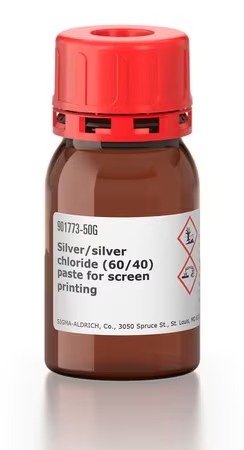
Sigma-Aldrich™ Silver/Silver Chloride (60/40) Paste for Screen Printing, 50g
Catalog No :
CAS Number :
Brand :
In Stock
Specifications:
| Application | Electrochemistry | ||
| Storage Temperature | Ambient | ||
| Product Type | Laboratory Chemical | Forms | Paste |
| Product Brand | Sigma-Aldrich | ||
| Product Grade | Analytical grade | Formula | Ag/AgCl |
High-performance Ag/AgCl conductive paste for reference electrodes, sensors, and printed electronics
Sigma-Aldrich™ Silver/Silver Chloride (Ag/AgCl) Paste (60/40) is a highly conductive, screen-printable reference electrode paste designed for fabrication of electrochemical sensors, diagnostic devices, environmental monitoring electrodes, and flexible printed electronics. With a precisely controlled 60% silver / 40% silver chloride ratio, this paste delivers excellent electrochemical stability, consistent potential behavior, and efficient conductivity for high-performance sensor platforms.
This material is supplied as a ready-to-print paste, optimized for polyester mesh screens and low-temperature curing. It is widely used in academic research, environmental analysis, biomedical diagnostics, and printed electronics manufacturing.
Key Features & Benefits
High Electrochemical Stability
- Ideal for forming reference electrodes in voltammetric, potentiometric, and amperometric systems
- Reliable and reproducible electrode potential under varied environmental and ionic conditions
Optimized Conductivity & Performance
- Sheet resistivity <100 mΩ/sq (20 µm thick film on alumina)
- High signal consistency for analytical and sensing applications
- Provides robust adhesion to a wide variety of substrates
Screen-Printing Optimized
- Coverage: 200 cm²/g (156 mesh polyester screen)
- Viscosity: 2.0–5.5 Pa·s for excellent print definition
- Long screen life (>3 hours) for production-scale workflows
- Suitable for semi-automatic and manual screen printers
- Not recommended for stainless steel mesh (corrosion possible)
Low-Temperature Curing
- 60°C for 30 minutes, or
- 80°C for 10 minutes
- Compatible with heat-sensitive substrates
Chemical & Technical Information
| Parameter | Details |
|---|---|
| Composition | Silver/Silver Chloride (60/40) |
| Form | Paste |
| Coverage | 200 cm²/g |
| Sheet Resistivity | <100 mΩ/sq |
| Viscosity | 2.0–5.5 Pa·s |
| Recommended Screen Types | Polyester, 156–230 tpi |
| Clean-Up Solvent | Ethoxy propanol or Sericol cleaners |
| Substrates | Polyester, PVC, polycarbonate, alumina |
| Linear Formula | Ag/AgCl |
| UNSPSC Code | 12141740 |
| NACRES Code | NA.23 |
Applications
1. Environmental & Chemical Sensors
Used extensively for:
- Heavy metal detection in water
- Multi-analyte electrochemical sensing
- Detection of dissolved oxygen, pH, anions, and pollutants
2. Biomedical & Diagnostic Devices
- Point-of-care disposable sensors
- Potentiometric glucose and metabolite dipstick sensors
- Electrochemical biosensors
3. Printed Electronic Devices
- Ag/AgCl reference electrode tracks
- Flexible circuit printing
- Disposable test strips
- Lab-on-chip systems
4. Research & Academic Applications
Cited in numerous peer-reviewed studies, including:
- Environmental remediation sensors (Palisoc et al., 2021)
- Oxygen gas detection in RT ionic liquids (Lee et al., 2017)
- Cosmetic analyte quantification sensors (Charoenkitamorn et al., 2022)
- Urine glucose detection systems (Caldara et al., 2023)
- Multi-analyte electrochemical detection platforms (Kunpatee et al., 2020)
Processing & Handling
Screen-Printing Guidelines
- Use polyester mesh (156–230 tpi)
- Avoid stainless steel mesh (corrosive reaction possible)
- Use plastic palette knives, not metal
Drying Conditions
- 60°C for 30 minutes
- or 80°C for 10 minutes
Compatible Substrates
- Polyester
- PVC
- Polycarbonate
- Alumina
Ordering Information
| Pack Size | SKU |
|---|---|
| 50 g | 901773-50G |
Sigma-Aldrich™ Ag/AgCl (60/40) Screen-Printing Paste is a premium conductive reference electrode material optimized for electrochemical sensors, diagnostics, environmental monitoring, and printed electronic devices. Its high stability, excellent conductivity, and printability make it a trusted choice for research labs and manufacturing environments requiring dependable Ag/AgCl electrode performance.