



 0
0

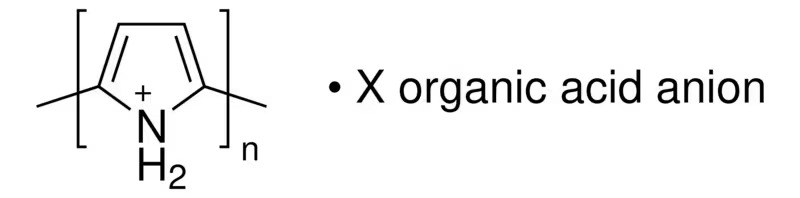


Sigma-Aldrich Polypyrrole (PPy), Doped, 30 S/cm Conductivity, 20 wt% Composite with Carbon Black, 25g
Catalog No :
CAS Number :
Brand :
In Stock
Specifications:
| Application | Analytical Chemistry | ||
| Storage Temperature | Ambient | ||
| Product Type | Laboratory Chemical | Forms | Solid |
| Product Brand | Sigma-Aldrich | ||
| Product Grade | Analytical grade | ||
Sigma-Aldrich Polypyrrole (PPy) is a doped, high-conductivity (30 S/cm, bulk) conductive polymer supplied as a solid composite containing 20 wt% polypyrrole loaded onto carbon black. The material is doped using a proprietary organic sulfonic acid, providing enhanced charge mobility, improved electrochemical responsiveness, and excellent oxidative stability up to 300 °C.
This engineered composite combines the high conductivity of PPy with the surface area and structural reinforcement of carbon black, producing a versatile conductive additive that is widely used in supercapacitors, lithium-ion batteries, fuel cells, chemical sensors, biosensors, thermoplastics, thermosets, and electronic inks.
As an enabling Greener Alternative Product, this polypyrrole is manufactured in alignment with energy-efficient green chemistry principles.
Key Features & Benefits
High Conductivity (30 S/cm, Bulk)
- Excellent electrical conductivity for advanced electrochemical devices
- Suitable for charge storage, sensing, and EMI applications
- Enhanced electron transport due to dopant incorporation
20 wt% Polypyrrole / Carbon Black Composite
- Combines PPy conductivity with high-surface-area carbon black
- Improves dispersion in polymer matrices and electrode slurries
- Enhances electrochemical performance and mechanical stability
Doped for Superior Performance
- Doped with a proprietary organic sulfonic acid dopant
- Improved charge-carrier mobility and structural stability
- Tunable surface charge properties for sensing and biosensor work
Thermally Stable & Highly Robust
- Decomposition/transition temperature >300 °C
- Chemically stable heterocyclic polymer backbone
- Insoluble in water and common organic solvents
Greener Alternative Product
- Designed in accordance with Green Chemistry Principles
- Energy-efficient production
- Sustainable enabling material for low-energy devices
Chemical & Regulatory Information
| Parameter | Details |
|---|---|
| Chemical Name | Polypyrrole |
| Synonym(s) | PPy |
| CAS Number | 30604-81-0 |
| MDL Number | MFCD00284347 |
| UNSPSC Code | 12352103 |
| Form | Solid composite |
| Dopant | Proprietary organic sulfonic acid |
| Conductivity | 30 S/cm (bulk) |
| Extent of Labeling | 20 wt% polypyrrole loading |
| Melting Point | >300 °C |
| Solubility | Insoluble in water and organic solvents |
| Sustainability Category | Greener Alternative Product (Enabling) |
| Structure (SMILES) | [nH]1cccc1 |
| InChI Key | KAESVJOAVNADME-UHFFFAOYSA-N |
Applications
1. Energy Storage & Electrochemical Devices
- Supercapacitors
- Lithium-ion, sodium-ion, and hybrid batteries
- Conductive layers in dye-sensitized solar cells (DSSCs)
- Fuel cell electrode components
2. Sensors & Biosensors
- Chemical sensors (gas, pH, VOC detection)
- Electrochemical biosensors (glucose, DNA, enzyme-based)
- Electrosensitive actuator materials
3. Conductive Additives
- Thermoplastics and thermosets
- Conductive polymer composites
- Antistatic and EMI shielding materials
- Electronic inks and printable electronics
4. Advanced Materials & Research
- Smart materials and responsive polymers
- Catalytic supports
- Capacitive deionization systems
- Flexible electronics and wearable sensors
Physical Properties
| Property | Value |
|---|---|
| Form | Solid |
| Color | Black composite |
| Thermal Stability | Stable ≥300 °C |
| Electrical Conductivity | ~30 S/cm |
| Solubility | Insoluble in H₂O & organic solvents |
| Composite Structure | 20 wt% polypyrrole + carbon black |
Packaging
- Packaged in glass bottles to ensure stability and prevent contamination.
-
Typical pack size:
- 25 g (SKU: 530573-25G)
Sigma-Aldrich Polypyrrole (PPy), doped and loaded at 20 wt% onto carbon black, offers high conductivity, excellent thermal stability, and superior electrochemical performance, making it a top-tier material for sensors, supercapacitors, batteries, coatings, and conductive polymer composites. Its insolubility, robustness, and energy-efficient production make it ideal for advanced research and industrial applications.