










 Contact us
  My Experiments


High-Sensitivity Intercalating Dye for Nucleic Acid Visualization and Cell-Based Assays
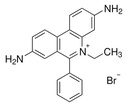
Ethidium bromide (EtBr) is a powerful nucleic acid intercalating dye widely used for visualization of DNA and RNA during agarose gel electrophoresis (AGE) and polyacrylamide gel electrophoresis (PAGE). When bound to double-stranded DNA or RNA, EtBr exhibits a 25- to 21-fold increase in fluorescence, respectively, making it highly sensitive even at low working concentrations (~0.5–10 µg/mL). EtBr is also used in fluorimetric assays, gel retardation studies, and cell viability analyses, thanks to its ability to intercalate nucleic acids and impact biological functions like DNA polymerase inhibition.
EtBr binds more strongly to double-stranded DNA, less so to single-stranded DNA, and can also bind triple-stranded DNA. It is considered a frameshift mutagen and is widely used in both routine molecular biology workflows and advanced research protocols.
Key Features & Benefits
✅ Strong Fluorescence Enhancement Upon Binding – 25-fold (dsDNA) and 21-fold (dsRNA) signal increase
✅ High Sensitivity – Detect as little as 1 ng of nucleic acid in gel electrophoresis
✅ No Destaining Required – Background remains low at standard working concentrations
✅ Multiple Application Formats – Compatible with in-gel staining, post-staining, and gel retardation assays
✅ Dual Use in Gels and Cells – Applied in both electrophoresis and fluorescence-based cell viability assays
✅ Reproducible and Cost-Effective – Long-standing, reliable choice for nucleic acid detection
Applications
- Agarose and Polyacrylamide Gel Electrophoresis – Visualization of DNA/RNA fragments
- Post-Staining and In-Gel Staining Protocols – Versatile use with or without destaining
- Polymerase Chain Reaction (PCR) Product Detection – Rapid identification of amplified fragments
- Fluorimetric Nucleic Acid Assays – Quantification and binding studies
- Cell Viability Assays – Used with acridine orange to differentiate apoptotic vs. necrotic cells
- Gel Retardation Assays – Analyze protein-DNA/RNA interactions
Technical Specifications
| Attribute | Specification |
|---|---|
| Product Name | Ethidium Bromide (EtBr) |
| Form | Liquid (commonly 10 mg/mL aqueous solution) |
| Working Concentration | 0.5–10 µg/mL |
| Excitation Maxima | 300 nm and 520 nm |
| Emission Maximum | 600 nm |
| Target Molecule | Double-stranded DNA and RNA |
| Binding Specificity | dsDNA > dsRNA > ssDNA/triplex DNA |
| Reagent Type | Intercalating Fluorescent Dye |
| Applications | Electrophoresis, Cell Imaging, Fluorimetric Assays |
| Storage Conditions | 15–30°C, away from light |
| Safety Classification | Mutagenic; handle with appropriate PPE |
| Research Use | For Research Use Only – Not for diagnostic use |
Reconstitution & Usage Guidelines
- For Post-Staining Gels: Dilute to 0.5 µg/mL in water, soak gel for 15–30 minutes. Optional destaining: 15 min in water.
- For In-Gel Staining: Add 0.5 µg/mL directly to gel and running buffer. Visualize DNA bands immediately after run.
- Cell-Based Assays: Apply with acridine orange for apoptotic and necrotic cell discrimination using fluorescence microscopy.
Biochemical Actions
- Intercalates between DNA/RNA bases, distorting the helical structure and blocking replication
- Inhibits DNA polymerase activity, especially at higher concentrations
- Acts as a frameshift mutagen in cellular and microbial systems
Ethidium Bromide (EtBr) remains a cornerstone reagent for nucleic acid visualization, offering unmatched sensitivity, versatility, and ease of use. Whether used in classic electrophoresis workflows or complex cellular assays, its strong fluorescence and compatibility with a wide range of nucleic acid forms make it a cost-effective, research-grade solution for DNA and RNA detection.
No resources are currently available for this product.
High-Sensitivity Intercalating Dye for Nucleic Acid Visualization and Cell-Based Assays
Ethidium bromide (EtBr) is a powerful nucleic acid intercalating dye widely used for visualization of DNA and RNA during agarose gel electrophoresis (AGE) and polyacrylamide gel electrophoresis (PAGE). When bound to double-stranded DNA or RNA, EtBr exhibits a 25- to 21-fold increase in fluorescence, respectively, making it highly sensitive even at low working concentrations (~0.5–10 µg/mL). EtBr is also used in fluorimetric assays, gel retardation studies, and cell viability analyses, thanks to its ability to intercalate nucleic acids and impact biological functions like DNA polymerase inhibition.
EtBr binds more strongly to double-stranded DNA, less so to single-stranded DNA, and can also bind triple-stranded DNA. It is considered a frameshift mutagen and is widely used in both routine molecular biology workflows and advanced research protocols.
Key Features & Benefits
✅ Strong Fluorescence Enhancement Upon Binding – 25-fold (dsDNA) and 21-fold (dsRNA) signal increase
✅ High Sensitivity – Detect as little as 1 ng of nucleic acid in gel electrophoresis
✅ No Destaining Required – Background remains low at standard working concentrations
✅ Multiple Application Formats – Compatible with in-gel staining, post-staining, and gel retardation assays
✅ Dual Use in Gels and Cells – Applied in both electrophoresis and fluorescence-based cell viability assays
✅ Reproducible and Cost-Effective – Long-standing, reliable choice for nucleic acid detection
Applications
- Agarose and Polyacrylamide Gel Electrophoresis – Visualization of DNA/RNA fragments
- Post-Staining and In-Gel Staining Protocols – Versatile use with or without destaining
- Polymerase Chain Reaction (PCR) Product Detection – Rapid identification of amplified fragments
- Fluorimetric Nucleic Acid Assays – Quantification and binding studies
- Cell Viability Assays – Used with acridine orange to differentiate apoptotic vs. necrotic cells
- Gel Retardation Assays – Analyze protein-DNA/RNA interactions
Technical Specifications
| Attribute | Specification |
|---|---|
| Product Name | Ethidium Bromide (EtBr) |
| Form | Liquid (commonly 10 mg/mL aqueous solution) |
| Working Concentration | 0.5–10 µg/mL |
| Excitation Maxima | 300 nm and 520 nm |
| Emission Maximum | 600 nm |
| Target Molecule | Double-stranded DNA and RNA |
| Binding Specificity | dsDNA > dsRNA > ssDNA/triplex DNA |
| Reagent Type | Intercalating Fluorescent Dye |
| Applications | Electrophoresis, Cell Imaging, Fluorimetric Assays |
| Storage Conditions | 15–30°C, away from light |
| Safety Classification | Mutagenic; handle with appropriate PPE |
| Research Use | For Research Use Only – Not for diagnostic use |
Reconstitution & Usage Guidelines
- For Post-Staining Gels: Dilute to 0.5 µg/mL in water, soak gel for 15–30 minutes. Optional destaining: 15 min in water.
- For In-Gel Staining: Add 0.5 µg/mL directly to gel and running buffer. Visualize DNA bands immediately after run.
- Cell-Based Assays: Apply with acridine orange for apoptotic and necrotic cell discrimination using fluorescence microscopy.
Biochemical Actions
- Intercalates between DNA/RNA bases, distorting the helical structure and blocking replication
- Inhibits DNA polymerase activity, especially at higher concentrations
- Acts as a frameshift mutagen in cellular and microbial systems
Ethidium Bromide (EtBr) remains a cornerstone reagent for nucleic acid visualization, offering unmatched sensitivity, versatility, and ease of use. Whether used in classic electrophoresis workflows or complex cellular assays, its strong fluorescence and compatibility with a wide range of nucleic acid forms make it a cost-effective, research-grade solution for DNA and RNA detection.
No resources are currently available for this product.