










 Contact us
  My Experiments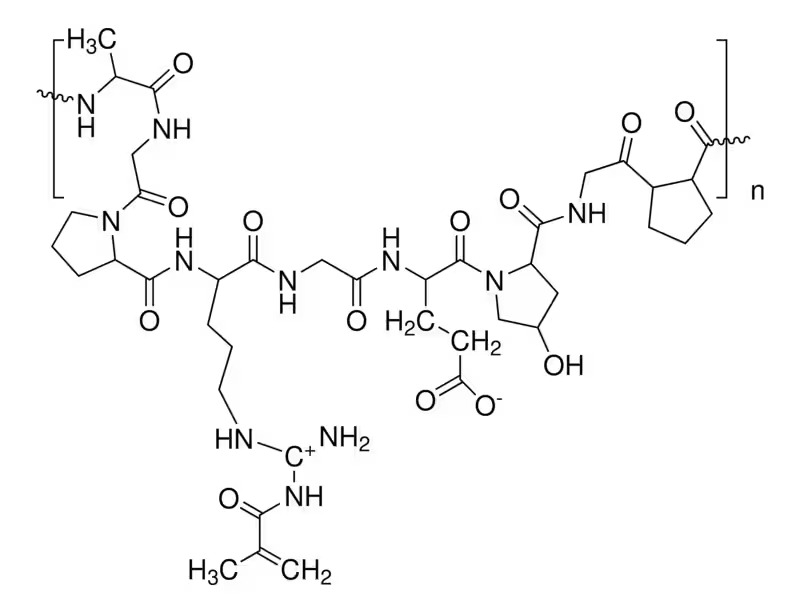
Photocrosslinkable Hydrogel Precursor for Tissue Engineering, 3D Bioprinting, and Regenerative Medicine
Sigma-Aldrich Gelatin Methacryloyl (GelMA) is a versatile, photocrosslinkable hydrogel material widely used in tissue engineering, regenerative medicine, drug delivery, and 3D bioprinting. Derived from gelatin modified with methacrylate groups, GelMA retains the biocompatibility and bioactivity of natural gelatin while enabling UV- or visible light-induced crosslinking in the presence of photoinitiators.
GelMA hydrogels mimic the native extracellular matrix (ECM) and provide tunable mechanical and biochemical properties, supporting cell encapsulation, proliferation, differentiation, and tissue morphogenesis.
Key Features & Benefits
- Photocrosslinkable – Forms hydrogels rapidly under UV/visible light with a photoinitiator
- Biocompatible & Bioactive – Promotes cell adhesion and matrix remodeling
- Tunable Mechanical Properties – Crosslinking density can be adjusted via light exposure or GelMA concentration
- Customizable Formats – Compatible with microspheres, injectable systems, and bioinks
- Supports Tissue Formation – Ideal for endothelial, cardiac, epidermal, cartilage, and bone tissue models
Applications
-
Tissue Engineering & Regenerative Medicine
- Endothelial cell morphogenesis
- Cardiomyocyte culture
- Epidermal and dermal constructs
- Bone differentiation and cartilage regeneration
-
3D Bioprinting
- Bioink for printing structured, cell-laden constructs
- Customizable for layer-by-layer tissue fabrication
-
Drug Delivery
- Controlled-release platforms using GelMA microspheres or hydrogels
-
Injectable Scaffolds
- In situ gelling for minimally invasive tissue repair
Sigma-Aldrich Gelatin Methacryloyl (GelMA) is a powerful, ECM-mimicking material for creating cell-compatible hydrogels in a wide range of biomedical applications. Its ease of crosslinking, adaptability to printing and injection, and promotion of tissue-specific cell behavior make it an essential tool for researchers in tissue engineering, drug delivery, and bioprinting.
No resources are currently available for this product.
Photocrosslinkable Hydrogel Precursor for Tissue Engineering, 3D Bioprinting, and Regenerative Medicine
Sigma-Aldrich Gelatin Methacryloyl (GelMA) is a versatile, photocrosslinkable hydrogel material widely used in tissue engineering, regenerative medicine, drug delivery, and 3D bioprinting. Derived from gelatin modified with methacrylate groups, GelMA retains the biocompatibility and bioactivity of natural gelatin while enabling UV- or visible light-induced crosslinking in the presence of photoinitiators.
GelMA hydrogels mimic the native extracellular matrix (ECM) and provide tunable mechanical and biochemical properties, supporting cell encapsulation, proliferation, differentiation, and tissue morphogenesis.
Key Features & Benefits
- Photocrosslinkable – Forms hydrogels rapidly under UV/visible light with a photoinitiator
- Biocompatible & Bioactive – Promotes cell adhesion and matrix remodeling
- Tunable Mechanical Properties – Crosslinking density can be adjusted via light exposure or GelMA concentration
- Customizable Formats – Compatible with microspheres, injectable systems, and bioinks
- Supports Tissue Formation – Ideal for endothelial, cardiac, epidermal, cartilage, and bone tissue models
Applications
-
Tissue Engineering & Regenerative Medicine
- Endothelial cell morphogenesis
- Cardiomyocyte culture
- Epidermal and dermal constructs
- Bone differentiation and cartilage regeneration
-
3D Bioprinting
- Bioink for printing structured, cell-laden constructs
- Customizable for layer-by-layer tissue fabrication
-
Drug Delivery
- Controlled-release platforms using GelMA microspheres or hydrogels
-
Injectable Scaffolds
- In situ gelling for minimally invasive tissue repair
Sigma-Aldrich Gelatin Methacryloyl (GelMA) is a powerful, ECM-mimicking material for creating cell-compatible hydrogels in a wide range of biomedical applications. Its ease of crosslinking, adaptability to printing and injection, and promotion of tissue-specific cell behavior make it an essential tool for researchers in tissue engineering, drug delivery, and bioprinting.
No resources are currently available for this product.
Specifications
| degree of substitution & Gel strength | gel strength 300 g Bloom, 80% degree of substitution, gel strength 300 g Bloom, degree of substitution 40%, gel strength 300 g Bloom, degree of substitution 60%, gel strength 90-110 g Bloom, degree of substitution 60%, gel strength 170-195 g Bloom, degree of substitution: 60% |