










 Contact us
  My Experiments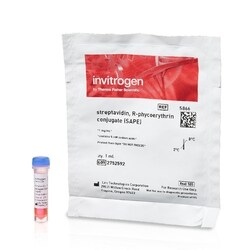
Streptavidin is a bacterially derived biotin-binding protein that exhibits less nonspecific binding than avidin. Phycoerythrin also known as R-Phycoerythrin (RPE) is an intensely bright phycobiliprotein isolated from red algae with absorption maxima at approximately 496, 546 and 565 nm, and a fluorescence emission maximum of ∼578 nm. Used in flow, microplate assays and microarrays, this has remained one of our top three selling products for decades—a proven performer that you can trust.
Important Features of Streptavidin RPE
• Biotin Detection with high quantum efficiency photoprotein
• 5–10 times brighter than organic fluors
• High water solubility
• Ideal for Flow, microarrays and microplate assays
• Also available as Premium grade with higher purity confirmed by HPLC (S21388)
Streptavidin and RPE
The high affinity of avidin, an egg-white protein, for biotin was first exploited in histochemical applications in the mid-1970s. Avidin, and its bacterial counterpart, streptavidin (from Streptomy cesavidinii), have since become standard reagents for diverse detection schemes. Streptavidin, a nonglycosylated 52,800-dalton protein, exhibits less nonspecific binding than avidin.
Rhodophyta Phycoerythrin (RPE) has a MW of 240,000 Daltons and has a quantum efficiency of 78% making it an incredibly bright reagent. However, the photostability is extremely poor and is not traditionally recommended for microscopy. But the broad absorption and bright orange signal may it ideal for flow, microplate and microarray applications whenever sensitive detection of biotins is required.
steptavidin.pdf
Streptavidin is a bacterially derived biotin-binding protein that exhibits less nonspecific binding than avidin. Phycoerythrin also known as R-Phycoerythrin (RPE) is an intensely bright phycobiliprotein isolated from red algae with absorption maxima at approximately 496, 546 and 565 nm, and a fluorescence emission maximum of ∼578 nm. Used in flow, microplate assays and microarrays, this has remained one of our top three selling products for decades—a proven performer that you can trust.
Important Features of Streptavidin RPE
• Biotin Detection with high quantum efficiency photoprotein
• 5–10 times brighter than organic fluors
• High water solubility
• Ideal for Flow, microarrays and microplate assays
• Also available as Premium grade with higher purity confirmed by HPLC (S21388)
Streptavidin and RPE
The high affinity of avidin, an egg-white protein, for biotin was first exploited in histochemical applications in the mid-1970s. Avidin, and its bacterial counterpart, streptavidin (from Streptomy cesavidinii), have since become standard reagents for diverse detection schemes. Streptavidin, a nonglycosylated 52,800-dalton protein, exhibits less nonspecific binding than avidin.
Rhodophyta Phycoerythrin (RPE) has a MW of 240,000 Daltons and has a quantum efficiency of 78% making it an incredibly bright reagent. However, the photostability is extremely poor and is not traditionally recommended for microscopy. But the broad absorption and bright orange signal may it ideal for flow, microplate and microarray applications whenever sensitive detection of biotins is required.