










 Contact us
  My Experiments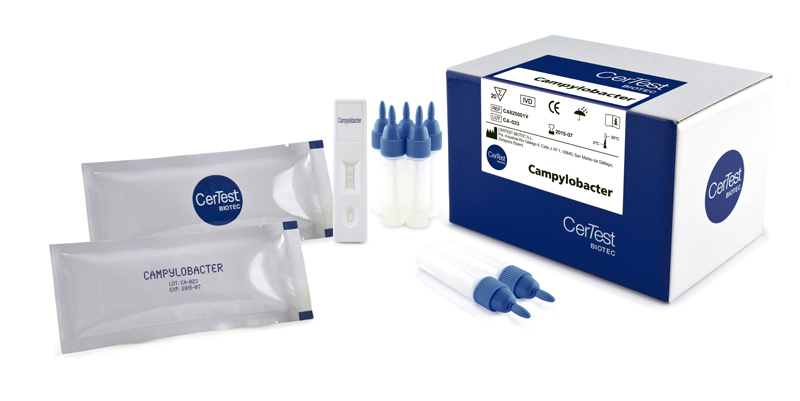
CerTest Campylobacter one step card test is a coloured chromatographic immunoassay for the qualitative detection of Campylobacter spp. in stool samples and Campylobacter spp. suspected colonies in stool culture.
CerTest Campylobacter card test offers a simple and a highly screening assay to make a presumptive diagnosis of Campylobacter spp. infection (campylobacterioris) and it could be used to identify of suspected isolates of Campylobacter from selective media (stool culture).
Information
Campylobacteriosis is the disease caused by the presence of Campylobacter spp.
The common routes of transmission are faecal-oral, personto-person sexual contact, ingestion of contaminated food or water, and the eating of raw meat. The onset of disease symptoms usually occurs two to five days after infection, but can range from one to ten days.
There are 16 species and 6 subspecies assigned to the genus Campylobacter, of which the most frequently reported in human disease are C. jejuni (subspecies jejuni) and C. coli (99% C. jejuni). C. laridis and C. upsaliensis are also regarded as primary pathogens, but are generally reported far less frequently in cases of human disease.
The most common clinical symptoms of Campylobacter infections include diarrhoea (frequently with blood in the faeces), abdominal pain, fever, headache, nausea, and/or vomiting. The symptoms typically last three to six days
No resources are currently available for this product.
CerTest Campylobacter one step card test is a coloured chromatographic immunoassay for the qualitative detection of Campylobacter spp. in stool samples and Campylobacter spp. suspected colonies in stool culture.
CerTest Campylobacter card test offers a simple and a highly screening assay to make a presumptive diagnosis of Campylobacter spp. infection (campylobacterioris) and it could be used to identify of suspected isolates of Campylobacter from selective media (stool culture).
Information
Campylobacteriosis is the disease caused by the presence of Campylobacter spp.
The common routes of transmission are faecal-oral, personto-person sexual contact, ingestion of contaminated food or water, and the eating of raw meat. The onset of disease symptoms usually occurs two to five days after infection, but can range from one to ten days.
There are 16 species and 6 subspecies assigned to the genus Campylobacter, of which the most frequently reported in human disease are C. jejuni (subspecies jejuni) and C. coli (99% C. jejuni). C. laridis and C. upsaliensis are also regarded as primary pathogens, but are generally reported far less frequently in cases of human disease.
The most common clinical symptoms of Campylobacter infections include diarrhoea (frequently with blood in the faeces), abdominal pain, fever, headache, nausea, and/or vomiting. The symptoms typically last three to six days
No resources are currently available for this product.