



 0
0
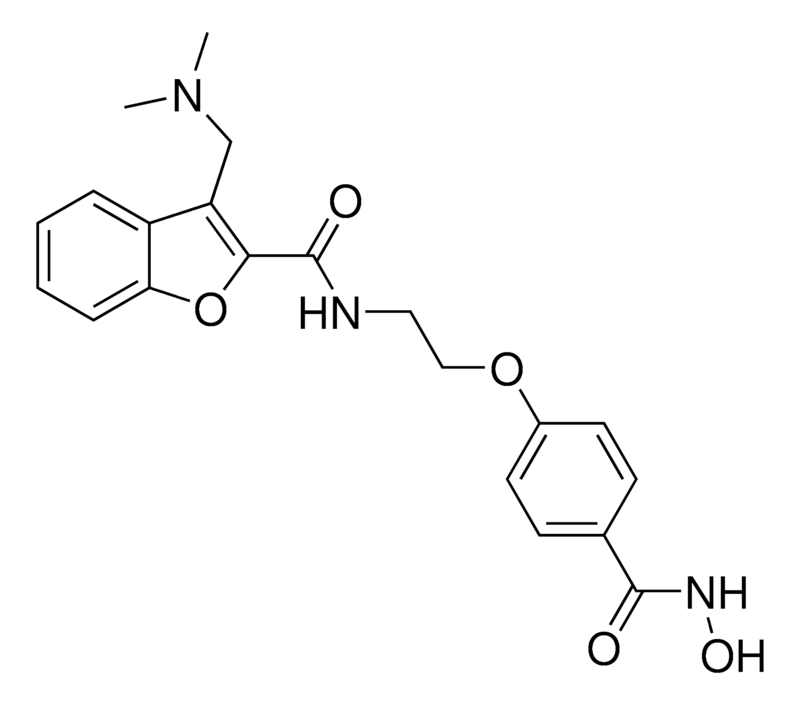
Specifications:
| Application | Protein Biology | ||
| Storage Temperature | -20°C | ||
| Product Type | Proteins & Peptides | Forms | Solid |
| Product Brand | Selleckchem | ||
| Product Grade | Analytical grade | Formula | C21H23N3O5 |
Abexinostat, also known as PCI-24781 or CRA-024781, is a novel pan-histone deacetylase (HDAC) inhibitor with potent activity against multiple HDAC isoforms. It primarily targets HDAC1, with a reported Ki of 7 nM, and also shows activity against HDAC2, HDAC3/SMRT, HDAC6, and HDAC10. Abexinostat demonstrates greater than 40-fold selectivity against HDAC8 compared with HDAC1.
As an epigenetic research compound, Abexinostat is widely studied in cancer biology, chromatin regulation, apoptosis, DNA damage response, homologous recombination repair, and cell cycle regulation. It has been investigated in preclinical and clinical research settings, including Phase 1/2 studies.
Key Features
- Novel pan-HDAC inhibitor
- Potently targets HDAC1 with Ki = 7 nM
- Active against HDAC2, HDAC3/SMRT, HDAC6, and HDAC10
- Greater than 40-fold selectivity against HDAC8
- Induces accumulation of acetylated histones and acetylated tubulin
- Promotes p21 expression, PARP cleavage, and γH2AX accumulation
- Studied in tumour cell proliferation, apoptosis, DNA damage, and homologous recombination research
- Suitable for epigenetics, oncology, and cell signalling research
- For research use only
Target Profile
| Target | Assay Type | Reported Activity |
|---|---|---|
| HDAC1 | Cell-free assay | Ki = 7 nM |
| HDAC3/SMRT | Cell-free assay | Ki = 8.2 nM |
| HDAC6 | Cell-free assay | Ki = 17 nM |
| HDAC2 | Cell-free assay | Ki = 19 nM |
| HDAC10 | Cell-free assay | Ki = 24 nM |
Biological Activity
Abexinostat has demonstrated potent antitumour activity against a range of tumour cell lines, with reported GI50 values ranging from 0.15 µM to 3.09 µM. It has also shown antiproliferative activity in HUVEC endothelial cells, with a reported GI50 of 0.43 µM.
In cellular studies, Abexinostat treatment has been associated with:
| Observed Effect | Research Relevance |
|---|---|
| Accumulation of acetylated histones | Confirms HDAC inhibition and chromatin modulation |
| Accumulation of acetylated tubulin | Indicates HDAC6-related activity |
| Induction of p21 expression | Supports cell cycle regulation studies |
| PARP cleavage | Marker associated with apoptosis research |
| γH2AX accumulation | Supports DNA damage response studies |
| RAD51 transcriptional repression | Relevant to homologous recombination repair research |
| S-phase depletion and G2 cell cycle arrest | Useful in cell cycle analysis |
| Caspase and ROS-dependent apoptosis | Relevant to lymphoma and cancer cell death studies |
In Vitro Research Applications
| Research Area | Typical Use |
|---|---|
| Cancer Biology | Evaluation of tumour cell proliferation, apoptosis, and cell cycle arrest |
| Epigenetics | Study of HDAC inhibition and histone acetylation |
| DNA Damage Response | Investigation of γH2AX accumulation and DNA repair pathways |
| Homologous Recombination Research | Study of RAD51 suppression and DNA repair inhibition |
| Cell Cycle Studies | Analysis of S-phase depletion and G2 arrest |
| Apoptosis Research | Evaluation of PARP cleavage, caspase activation, and ROS-dependent cell death |
| Angiogenesis Research | Assessment of antiproliferative effects in endothelial cells |
| Lymphoma Research | Investigation of NF-κB-related apoptotic mechanisms |
Cell Line Research Data
| Parameter | Details |
|---|---|
| Cell Lines Studied | HCT116, HCT-15, BT-549, NCI-H226, CWR-22RV1, MCF-7, NCI-PC3, DLD-1, SKOV-3, OVCAR-3 |
| Solvent | DMSO |
| Final Concentration Range | Approximately 0.0015–10 µM |
| Typical Exposure Time | 48, 72, 96, or 120 hours |
| Assay Method | Alamar Blue fluorometric cell proliferation assay |
| Readout | GI50 determination using nonlinear regression |
HDAC Activity Assay Summary
HDAC activity is commonly assessed using a continuous trypsin-coupled fluorescence assay. In this assay, HDAC enzyme preparations are incubated with Abexinostat at different concentrations, followed by addition of trypsin and fluorogenic acetylated peptide substrates.
| Assay Parameter | Details |
|---|---|
| Reaction Volume | 100 µL |
| Plate Format | 96-well assay plate |
| Buffer System | HEPES/KCl/Tween 20/DMSO, pH 7.4 |
| Pre-Incubation | 15 minutes with inhibitor |
| Detection | Fluorescence plate reader |
| Excitation Wavelength | 355 nm |
| Emission Wavelength | 460 nm |
| Output | Reaction rate and Ki determination |
In Vivo Research Summary
In mouse xenograft studies, Abexinostat has been evaluated in HCT116 and DLD-1 tumour models. Reported findings include dose-dependent tumour growth inhibition following intravenous administration.
| Parameter | Details |
|---|---|
| Animal Model | Female BALB/c nu/nu mice |
| Tumour Models | HCT116 and DLD-1 xenografts |
| Route | Intravenous administration |
| Example Dose | Approximately 200 mg/kg |
| Reported Outcome | Inhibition of tumour growth in xenograft models |
Technical Summary
| Parameter | Details |
|---|---|
| Product Name | Abexinostat |
| Synonyms | PCI-24781, CRA-024781 |
| Compound Class | Pan-HDAC inhibitor |
| Primary Target | HDAC1 |
| Primary Target Activity | Ki = 7 nM |
| Selectivity | Greater than 40-fold selectivity against HDAC8 |
| Research Areas | Epigenetics, oncology, apoptosis, DNA repair, cell cycle regulation |
| Solubility in Studies | Dissolved in DMSO |
| Clinical Research Stage | Phase 1/2 |
| Intended Use | Research use only |
Storage and Handling Notes
Abexinostat should be handled as a research chemical by trained laboratory personnel using appropriate safety procedures.
Recommended handling considerations include:
- Store according to supplier recommendations
- Prepare stock solutions using suitable solvent, commonly DMSO
- Avoid repeated freeze-thaw cycles of prepared aliquots
- Protect compound solutions from unnecessary exposure to light and moisture
- Use appropriate PPE, including gloves, lab coat, and eye protection
- Dispose of compound waste according to institutional chemical safety procedures
Abexinostat / PCI-24781 / CRA-024781 is a potent pan-HDAC inhibitor with strong activity against HDAC1, HDAC2, HDAC3, HDAC6, and HDAC10. It is widely used in epigenetics and oncology research to study histone acetylation, tubulin acetylation, tumour cell growth inhibition, apoptosis, DNA damage response, RAD51-mediated homologous recombination, and cell cycle arrest. Its broad HDAC inhibition profile makes it a valuable research compound for cancer biology, chromatin regulation, and therapeutic mechanism studies.
- Pack Size: 10mg 50mg 1g 5mg 10 mM x 1 mL in DMSO 200mg