















 Contact us
  My Experiments
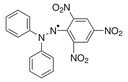


2,2-Diphenyl-1-picrylhydrazyl (DPPH) is a highly stable free radical commonly used as a sensitive colorimetric reagent in antioxidant detection and other free radical-related studies. It is particularly valuable for monitoring chemical reactions involving radicals and serves as a reference for electron paramagnetic resonance (EPR) studies.
Key Features:
- Applications:
- Antioxidant Assays: Used as a general detector for free radical scavenging activity.
- Chemical Reaction Monitoring: Monitors reactions involving radicals.
- EPR Studies: Standard for determining the position and intensity of EPR signals.
- Quantitative Determination: Measures aliphatic and aromatic thiols using indirect spectroscopy.
- Tocopherol Detection: Facilitates the photometric quantification of tocopherol.
- Physical Properties:
- Appearance: Green to black powder.
- Molecular Formula: C₁₈H₁₂N₅O₆.
- Molecular Weight: 394.32 g/mol.
- Chemical Stability:
- A stable free radical with consistent behavior under standard laboratory conditions.
- Pack Sizes:
- 250 mg: Catalog Number 44150.MD.
- 1 g: Catalog Number 44150.03.
Specifications:
| Property | Details |
|---|---|
| Purity | ≥95% |
| Appearance | Green to black powder |
| Molecular Formula | C₁₈H₁₂N₅O₆ |
| Molecular Weight | 394.32 g/mol |
| CAS Number | 1898-66-4 |
| MDL Number | MFCD00007231 |
| EINECS Number | 217-591-8 |
| Merck Index Number | 14,3330 |
Applications in Detail:
- Antioxidant Detection:
- Reacts with antioxidants to reduce the DPPH radical, causing a color change from purple to yellow, measurable spectrophotometrically at 517 nm.
- Radical Reaction Monitoring:
- Tracks the generation and scavenging of free radicals in chemical systems.
- EPR Standards:
- Provides a reference for the calibration of electron paramagnetic resonance equipment.
- Quantification of Thiols:
- Utilized for indirect spectroscopic measurements of thiol compounds.
- Photometric Tocopherol Determination:
- Allows precise quantification of tocopherol (Vitamin E) concentrations.
Advantages:
| Feature | Benefit |
|---|---|
| High Stability | Allows for reproducible and reliable measurements. |
| Colorimetric Assay | Enables easy visual and spectrophotometric detection of radical activity. |
| Versatile Applications | Suitable for antioxidant detection, EPR, and radical reaction monitoring. |
Storage and Handling:
- Store in a cool, dry place to maintain stability.
- Handle with care, following proper laboratory safety protocols.
Available Pack Sizes:
| Catalog Number | Pack Size | Container Type |
|---|---|---|
| 44150.MD | 250 mg | Sealed bottle |
| 44150.03 | 1 g | Sealed bottle |
No resources are currently available for this product.
2,2-Diphenyl-1-picrylhydrazyl (DPPH) is a highly stable free radical commonly used as a sensitive colorimetric reagent in antioxidant detection and other free radical-related studies. It is particularly valuable for monitoring chemical reactions involving radicals and serves as a reference for electron paramagnetic resonance (EPR) studies.
Key Features:
- Applications:
- Antioxidant Assays: Used as a general detector for free radical scavenging activity.
- Chemical Reaction Monitoring: Monitors reactions involving radicals.
- EPR Studies: Standard for determining the position and intensity of EPR signals.
- Quantitative Determination: Measures aliphatic and aromatic thiols using indirect spectroscopy.
- Tocopherol Detection: Facilitates the photometric quantification of tocopherol.
- Physical Properties:
- Appearance: Green to black powder.
- Molecular Formula: C₁₈H₁₂N₅O₆.
- Molecular Weight: 394.32 g/mol.
- Chemical Stability:
- A stable free radical with consistent behavior under standard laboratory conditions.
- Pack Sizes:
- 250 mg: Catalog Number 44150.MD.
- 1 g: Catalog Number 44150.03.
Specifications:
| Property | Details |
|---|---|
| Purity | ≥95% |
| Appearance | Green to black powder |
| Molecular Formula | C₁₈H₁₂N₅O₆ |
| Molecular Weight | 394.32 g/mol |
| CAS Number | 1898-66-4 |
| MDL Number | MFCD00007231 |
| EINECS Number | 217-591-8 |
| Merck Index Number | 14,3330 |
Applications in Detail:
- Antioxidant Detection:
- Reacts with antioxidants to reduce the DPPH radical, causing a color change from purple to yellow, measurable spectrophotometrically at 517 nm.
- Radical Reaction Monitoring:
- Tracks the generation and scavenging of free radicals in chemical systems.
- EPR Standards:
- Provides a reference for the calibration of electron paramagnetic resonance equipment.
- Quantification of Thiols:
- Utilized for indirect spectroscopic measurements of thiol compounds.
- Photometric Tocopherol Determination:
- Allows precise quantification of tocopherol (Vitamin E) concentrations.
Advantages:
| Feature | Benefit |
|---|---|
| High Stability | Allows for reproducible and reliable measurements. |
| Colorimetric Assay | Enables easy visual and spectrophotometric detection of radical activity. |
| Versatile Applications | Suitable for antioxidant detection, EPR, and radical reaction monitoring. |
Storage and Handling:
- Store in a cool, dry place to maintain stability.
- Handle with care, following proper laboratory safety protocols.
Available Pack Sizes:
| Catalog Number | Pack Size | Container Type |
|---|---|---|
| 44150.MD | 250 mg | Sealed bottle |
| 44150.03 | 1 g | Sealed bottle |
No resources are currently available for this product.
![[174070100] Thermo Scientific™ Quercetin hydrate, 95% (10g)](/web/image/product.product/20803/image_512/%5B174070100%5D%20Thermo%20Scientific%E2%84%A2%20Quercetin%20hydrate%2C%2095%25%20%2810g%29?unique=332c4ff)
![[36417.22] Thermo Scientific™ Gallic acid monohydrate ≥98% ACS (100g)](/web/image/product.product/20799/image_512/%5B36417.22%5D%20Thermo%20Scientific%E2%84%A2%20Gallic%20acid%20monohydrate%20%E2%89%A598%25%20ACS%20%28100g%29?unique=48604c7)
![[A15807.14] Thermo Scientific™ Quercetin dihydrate 97% (25g)](/web/image/product.product/20806/image_512/%5BA15807.14%5D%20Thermo%20Scientific%E2%84%A2%20Quercetin%20dihydrate%2097%25%20%2825g%29?unique=332c4ff)
![[B24887.0B] Thermo Scientific™ Gallic acid, anhydrous ≥98% (1kg)](/web/image/product.product/20802/image_512/%5BB24887.0B%5D%20Thermo%20Scientific%E2%84%A2%20Gallic%20acid%2C%20anhydrous%20%E2%89%A598%25%20%281kg%29?unique=48604c7)
![[OR51754-1KG] Apollo Sci. Gallic acid, anhydrous 99% (1kg)](/web/image/product.product/24984/image_512/%5BOR51754-1KG%5D%20Apollo%20Sci.%20Gallic%20acid%2C%20anhydrous%2099%25%20%281kg%29?unique=5661d2a)
Specifications
| Pack Size | 250mg, 1g |