



 0
0
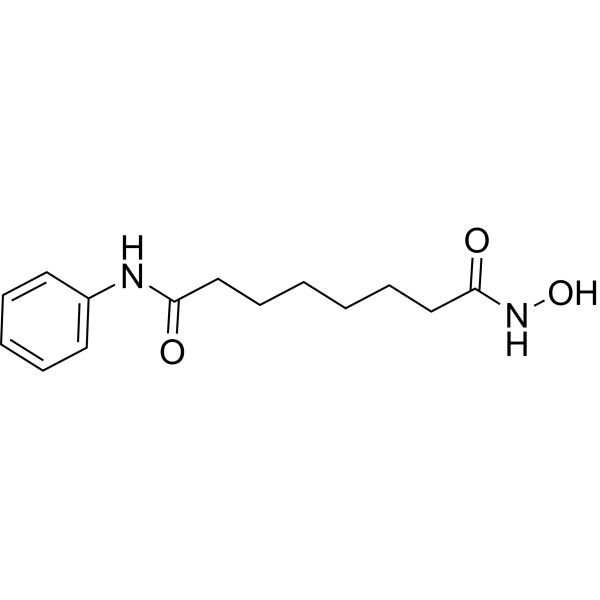
Vorinostat (SAHA) 99.96%
Catalog No :
CAS Number :
Brand :
In Stock
Histone Deacetylase Inhibitor
Specifications:
| Application | Life Science Applications | ||
| Storage Temperature | -20°C | ||
| Forms | Solid | ||
| Product Brand | Selleckchem | ||
| Product Grade | Analytical grade | Formula | C₁₄H₂₀N₂O₃ |
Vorinostat, also known as SAHA, is a potent histone deacetylase (HDAC) inhibitor used in epigenetics, oncology, cell cycle, apoptosis, and chromatin regulation research. It inhibits HDAC activity with a reported IC50 of approximately 10 nM in a cell-free assay and has demonstrated inhibitory activity against HDAC1 and HDAC3.
Vorinostat promotes histone hyperacetylation, particularly acetylation of histone H4, and is widely used to study transcriptional regulation, tumour cell growth inhibition, cell differentiation, apoptosis, and HDAC-dependent signalling pathways. It has been investigated in several cancer research models, including prostate cancer, breast cancer, multiple myeloma, and viral DNA amplification studies.
Key Features
- Potent HDAC inhibitor
- Also known as SAHA
- Reported HDAC IC50 of approximately 10 nM
- Inhibits HDAC1 and HDAC3
- Promotes hyperacetylation of histone H4
- Used in epigenetics and chromatin regulation research
- Studied in prostate cancer, breast cancer, multiple myeloma, and viral replication models
- Induces cell cycle changes, differentiation, and apoptosis in selected cell models
- Reported to abrogate productive HPV-18 DNA amplification
- For research use only
Target Profile
| Target | Assay Type | Reported Activity |
|---|---|---|
| HDAC | Cell-free assay | IC50 ≈ 10 nM |
| HDAC1 | Cell-free assay | IC50 = 10 nM |
| HDAC3 | Cell-free assay | IC50 = 20 nM |
Biological Activity
Vorinostat inhibits HDAC activity and promotes accumulation of acetylated histones, resulting in changes in chromatin structure and gene expression regulation. In cell-based studies, Vorinostat has been shown to inhibit cancer cell proliferation, induce cell cycle arrest, promote differentiation, and trigger apoptosis depending on the cell model and treatment conditions.
In prostate cancer cell lines including LNCaP, PC-3, and TSU-Pr1, Vorinostat inhibits cell growth at micromolar concentrations and induces dose-dependent cell death in LNCaP cells. In MCF-7 breast cancer cells, Vorinostat inhibits proliferation with a reported IC50 of 0.75 µM, causing accumulation of cells in the G1 and G2-M phases of the cell cycle.
In Vitro Research Applications
| Research Area | Typical Use |
|---|---|
| Epigenetics Research | Study of HDAC inhibition and histone acetylation |
| Chromatin Biology | Investigation of transcriptional regulation through histone modification |
| Cancer Biology | Assessment of tumour cell proliferation, differentiation, and apoptosis |
| Prostate Cancer Research | Evaluation of growth inhibition in LNCaP, PC-3, and TSU-Pr1 cells |
| Breast Cancer Research | Study of cell cycle changes and differentiation in MCF-7, SKBr-3, and MDA-468 cells |
| Multiple Myeloma Research | Investigation of apoptosis and gene expression changes |
| Viral Research | Study of HPV-18 DNA amplification and epigenetic regulation |
| Cell Cycle Studies | Analysis of G1 and G2-M phase accumulation |
| Apoptosis Research | Evaluation of cell death pathways and apoptosis-related gene regulation |
Cell-Based Research Data
| Parameter | Details |
|---|---|
| Cell Lines Studied | LNCaP, PC-3, TSU-Pr1, MCF-7, SKBr-3, MDA-468, human multiple myeloma cells |
| Solvent | DMSO |
| Example Concentration Range | Micromolar range; up to approximately 7.5 µM in selected studies |
| Example Incubation Time | 1, 2, 3, and 4 days |
| Assay Method | Trypan blue dye exclusion for cell viability |
| Reported MCF-7 IC50 | 0.75 µM |
| Example Biomarkers | Ac-Histone H4, Ac-Histone H3, p21, CHOP, ATF4, Cyclin B1, c-Myc, Akt, Cyclin D1, CDK4 |
HDAC Assay Summary
Vorinostat has been evaluated using immunoprecipitation-HDAC assays. In this method, HDAC1 or HDAC3 immune complexes are prepared from Jurkat cell lysates and incubated with a radiolabelled histone H4 peptide substrate. HDAC inhibition is assessed by measuring released radiolabelled acetic acid.
| Assay Parameter | Details |
|---|---|
| Source Material | Jurkat cell lysate |
| HDAC Targets | HDAC1 and HDAC3 immune complexes |
| Antibody Type | Anti-HDAC1 or anti-HDAC3 polyclonal antisera |
| Substrate | ³H-acetylated histone H4 peptide |
| Pre-Incubation with Inhibitor | 30 minutes at 4°C |
| Detection Method | Scintillation counting |
| Readout | Released ³H-acetic acid |
In Vivo Research Summary
Vorinostat has been studied in mouse xenograft and neurological disease models. In CWR22 human prostate cancer xenografts in nude mice, Vorinostat administration produced dose-dependent tumour growth inhibition. In an R6/2 mouse model of Huntington’s disease, oral administration was reported to cross the blood-brain barrier, increase histone acetylation in the brain, and improve motor impairment in the model.
| Parameter | Details |
|---|---|
| Animal Model | Male BALB/c nude mice implanted with CWR22 tumour cells |
| Dose Levels | 25, 50, and 100 mg/kg/day |
| Administration Route | Intraperitoneal injection |
| Reported Outcome | Dose-dependent inhibition of tumour growth |
| Additional Model | R6/2 mouse model of Huntington’s disease |
| Additional Route | Oral administration in drinking formulation |
| Research Effect | Increased brain histone acetylation and improved motor impairment in model studies |
Research Findings Summary
| Observation | Research Relevance |
|---|---|
| Inhibits HDAC activity | Supports studies of histone deacetylase biology |
| Promotes histone H4 hyperacetylation | Useful for chromatin and transcriptional regulation research |
| Inhibits prostate cancer cell growth | Relevant to oncology and antiproliferative studies |
| Causes G1 and G2-M accumulation in MCF-7 cells | Supports cell cycle regulation studies |
| Induces differentiation in selected breast cancer cell models | Useful in differentiation and tumour biology research |
| Induces apoptosis in multiple myeloma cells | Relevant to cell death and haematological cancer research |
| Alters specific functional gene groups | Supports gene expression and pathway analysis studies |
| Abrogates productive HPV-18 DNA amplification | Useful for viral epigenetics and HPV-related research |
Technical Summary
| Parameter | Details |
|---|---|
| Product Name | Vorinostat |
| Synonym | SAHA |
| Compound Class | HDAC inhibitor |
| Primary Activity | HDAC inhibition |
| Reported HDAC IC50 | Approximately 10 nM |
| HDAC1 IC50 | 10 nM |
| HDAC3 IC50 | 20 nM |
| Common Solvent | DMSO |
| Research Areas | Epigenetics, oncology, chromatin biology, apoptosis, cell cycle, viral DNA amplification |
| Intended Use | Research use only |
Storage and Handling Notes
Vorinostat should be handled as a research compound by trained laboratory personnel using appropriate chemical safety procedures.
Recommended handling considerations include:
- Store according to supplier recommendations
- Prepare stock solutions using a suitable solvent such as DMSO
- Aliquot stock solutions where repeated use is expected
- Avoid repeated freeze-thaw cycles of prepared solutions
- Protect compound solutions from unnecessary exposure to light and moisture
- Use appropriate PPE, including gloves, lab coat, and eye protection
- Dispose of chemical waste according to institutional safety procedures
Vorinostat / SAHA is a potent HDAC inhibitor used extensively in epigenetics, oncology, chromatin regulation, apoptosis, and cell cycle research. With nanomolar HDAC inhibitory activity, demonstrated effects on histone acetylation, tumour cell growth, differentiation, and apoptosis, it is a valuable research compound for studying HDAC-dependent mechanisms across cancer biology and related biomedical research models.
- Pack Size: 10g 500mg 10 mM x 1 mL in DMSO 200mg 2g