










 Contact us
  My Experiments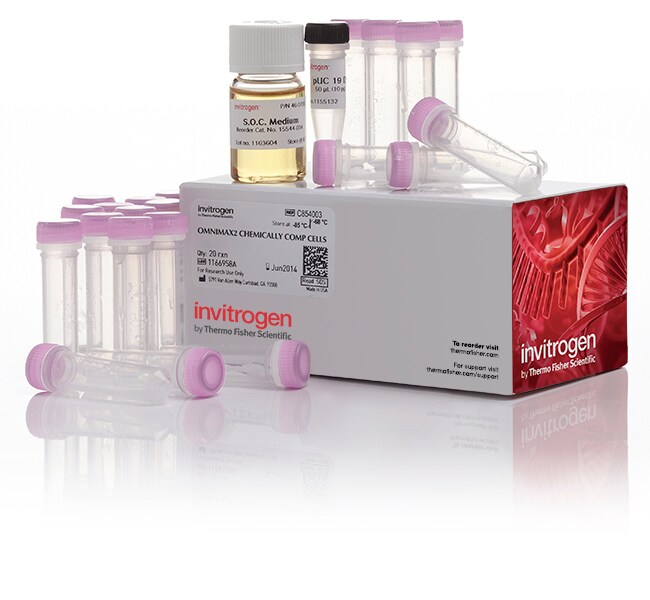
Invitrogen One Shot™ BL21 Star™ (DE3) Chemically Competent E. coli is an advanced strain optimized for the high-level expression of recombinant proteins. It is particularly suited for low-copy-number, T7-promoter-based systems, offering enhanced mRNA stability and reduced proteolysis.
Key Features:
- High Protein Expression:
- Enhanced mRNA stability due to the rne131 mutation, which reduces endogenous RNase activity.
- Supports T7 RNA polymerase-driven expression, yielding high levels of recombinant protein.
- Reduced Protein Degradation:
- Protease Deficiency: Lacks lon and OmpT proteases, minimizing degradation of heterologous proteins.
- Optimized for Low-Copy Plasmids:
- Specifically designed for low-copy-number T7-promoter-based plasmids such as Champion™ pET vectors.
- Single-Tube Transformation:
- Supplied in the One Shot™ format, allowing transformation and plating in the same tube to save time and prevent contamination.
- Fast Growth and High Density:
- Exhibits rapid growth in minimal media and reaches high cell density in glucose-rich media with low acetate production.
- Inducible Expression System:
- Expression of the T7 RNA polymerase is controlled by the lacUV5 promoter and induced with IPTG.
Applications:
- Recombinant Protein Production:
- High-yield production of non-toxic proteins for research or industrial purposes.
- T7 Promoter Systems:
- Supports low-copy-number T7 plasmids like Champion™ pET vectors.
- RNA Stability Studies:
- Increased stability of mRNA for higher yields of recombinant protein.
Specifications:
| Attribute | Details |
|---|---|
| Product Type | Chemically Competent Cells |
| Transformation Efficiency | Medium Efficiency (1 × 10⁸ cfu/μg pUC19 DNA) |
| Promoter | T7 |
| RNA Stability | Enhanced (rne131 mutation) |
| Protein Stability | Enhanced (lon, ompT protease deficiencies) |
| High-throughput Compatibility | Low |
| Phage Resistance | Not resistant to T1 phage |
| Blue/White Screening | Not supported |
| Cloning Methylated DNA | Not supported |
| Format | Tube |
| Species | E. coli (B strain) |
| Plasmid Size | Suitable for low-copy-number plasmids |
| Storage Temperature | Cells: -80°C pUC19 DNA: -20°C S.O.C.: 4°C |
| Shipping Conditions | Dry Ice |
Genotype:
- F– ompT hsdSB (rB–, mB–) gal dcm rne131 (DE3)
Kit Contents:
| Component | Quantity | Storage Conditions |
|---|---|---|
| BL21 Star™ (DE3) Cells | 21 x 50 μL | –80°C |
| pUC19 DNA | 50 μL (10 pg/μL) | –20°C |
| S.O.C. Medium | 6 mL | 4°C or room temperature |
Advantages:
| Feature | Benefit |
|---|---|
| Enhanced mRNA Stability | Increased transcript stability improves yields. |
| Reduced Protease Activity | Minimizes degradation of recombinant proteins. |
| Optimized for T7 Systems | Reliable performance with low-copy plasmids. |
| Convenient Format | Single-tube workflow saves time and reduces contamination risk. |
Handling and Storage:
- Store Competent Cells: –80°C.
- Store pUC19 DNA: –20°C.
- Store S.O.C. Medium: 4°C or room temperature.
- Follow standard laboratory safety procedures during handling.
Comp Cells Brochure.pdf
Competent Cell Selection Guide.pdf
One Shot BL21 Star (DE3) and One Shot BL21 Star (DE3) pLysS Competent Cells IFU.pdf
Selection Guide; Choosing competent cells by application.pdf
This will display Shipping & Return.
Invitrogen One Shot™ BL21 Star™ (DE3) Chemically Competent E. coli is an advanced strain optimized for the high-level expression of recombinant proteins. It is particularly suited for low-copy-number, T7-promoter-based systems, offering enhanced mRNA stability and reduced proteolysis.
Key Features:
- High Protein Expression:
- Enhanced mRNA stability due to the rne131 mutation, which reduces endogenous RNase activity.
- Supports T7 RNA polymerase-driven expression, yielding high levels of recombinant protein.
- Reduced Protein Degradation:
- Protease Deficiency: Lacks lon and OmpT proteases, minimizing degradation of heterologous proteins.
- Optimized for Low-Copy Plasmids:
- Specifically designed for low-copy-number T7-promoter-based plasmids such as Champion™ pET vectors.
- Single-Tube Transformation:
- Supplied in the One Shot™ format, allowing transformation and plating in the same tube to save time and prevent contamination.
- Fast Growth and High Density:
- Exhibits rapid growth in minimal media and reaches high cell density in glucose-rich media with low acetate production.
- Inducible Expression System:
- Expression of the T7 RNA polymerase is controlled by the lacUV5 promoter and induced with IPTG.
Applications:
- Recombinant Protein Production:
- High-yield production of non-toxic proteins for research or industrial purposes.
- T7 Promoter Systems:
- Supports low-copy-number T7 plasmids like Champion™ pET vectors.
- RNA Stability Studies:
- Increased stability of mRNA for higher yields of recombinant protein.
Specifications:
| Attribute | Details |
|---|---|
| Product Type | Chemically Competent Cells |
| Transformation Efficiency | Medium Efficiency (1 × 10⁸ cfu/μg pUC19 DNA) |
| Promoter | T7 |
| RNA Stability | Enhanced (rne131 mutation) |
| Protein Stability | Enhanced (lon, ompT protease deficiencies) |
| High-throughput Compatibility | Low |
| Phage Resistance | Not resistant to T1 phage |
| Blue/White Screening | Not supported |
| Cloning Methylated DNA | Not supported |
| Format | Tube |
| Species | E. coli (B strain) |
| Plasmid Size | Suitable for low-copy-number plasmids |
| Storage Temperature | Cells: -80°C pUC19 DNA: -20°C S.O.C.: 4°C |
| Shipping Conditions | Dry Ice |
Genotype:
- F– ompT hsdSB (rB–, mB–) gal dcm rne131 (DE3)
Kit Contents:
| Component | Quantity | Storage Conditions |
|---|---|---|
| BL21 Star™ (DE3) Cells | 21 x 50 μL | –80°C |
| pUC19 DNA | 50 μL (10 pg/μL) | –20°C |
| S.O.C. Medium | 6 mL | 4°C or room temperature |
Advantages:
| Feature | Benefit |
|---|---|
| Enhanced mRNA Stability | Increased transcript stability improves yields. |
| Reduced Protease Activity | Minimizes degradation of recombinant proteins. |
| Optimized for T7 Systems | Reliable performance with low-copy plasmids. |
| Convenient Format | Single-tube workflow saves time and reduces contamination risk. |
Handling and Storage:
- Store Competent Cells: –80°C.
- Store pUC19 DNA: –20°C.
- Store S.O.C. Medium: 4°C or room temperature.
- Follow standard laboratory safety procedures during handling.
Comp Cells Brochure.pdf
Competent Cell Selection Guide.pdf
One Shot BL21 Star (DE3) and One Shot BL21 Star (DE3) pLysS Competent Cells IFU.pdf
Selection Guide; Choosing competent cells by application.pdf
This will display Shipping & Return.
![[10855001] Gibco™ LB Broth (1X) (1L)](/web/image/product.product/39914/image_512/%5B10855001%5D%20Gibco%E2%84%A2%20LB%20Broth%20%281X%29%20%281L%29?unique=96c5da2)
![[11593027] Gibco™ Ampicillin, sodium salt, irradiated, 200 mg](/web/image/product.product/39906/image_512/%5B11593027%5D%20Gibco%E2%84%A2%20Ampicillin%2C%20sodium%20salt%2C%20irradiated%2C%20200%20mg?unique=96c5da2)
![[A55800] Invitrogen™ One Shot™ LB Agar Plates (None)](/web/image/product.product/39910/image_512/%5BA55800%5D%20Invitrogen%E2%84%A2%20One%20Shot%E2%84%A2%20LB%20Agar%20Plates%20%28None%29?unique=96c5da2)