



 0
0
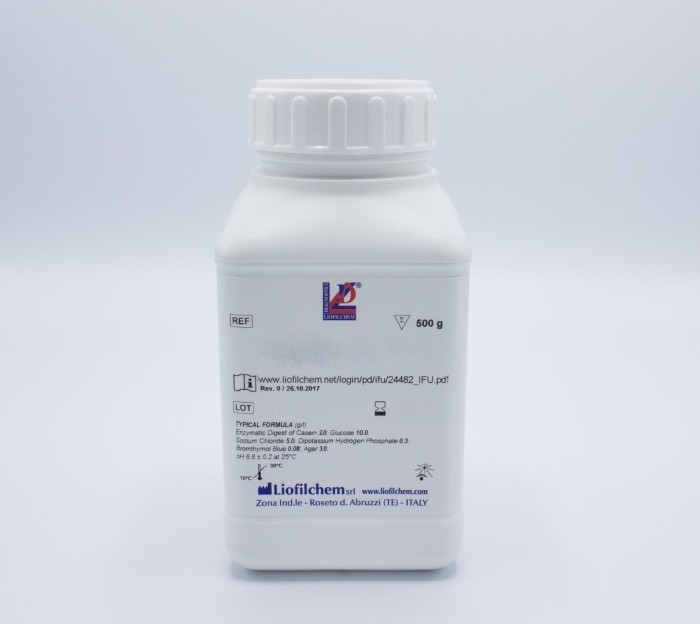
Liofilchem® BAT Agar, 500g
Catalog No :
CAS Number :
Brand :
In Stock
Medium for Detection of Alicyclobacillus spp. in Fruit Juices and Beverages
Specifications:
| Application | Industrial Microbiology | ||
| Storage Temperature | Ambient | ||
| Product Type | Culture Medium | Forms | Powder |
| Product Brand | Liofilchem | ||
| Product Grade | Microbiology grade | ||
Liofilchem® BAT Agar is a specialized bacteriological medium formulated for the detection and presumptive isolation of Alicyclobacillus species in fruit juices, concentrates, and other acidic beverages.
Alicyclobacillus spp. are thermophilic, acidophilic, spore-forming bacteria known for causing spoilage and off-flavors in pasteurized fruit products without visible gas formation.
This selective agar supports the recovery of Alicyclobacillus while suppressing common contaminating microflora through its low pH (4.0 ± 0.2) and optimized mineral composition.
Key Features
- Selective formulation designed specifically for detection of Alicyclobacillus spp.
- Low pH and mineral balance inhibit unwanted bacterial growth.
- Supports thermophilic, acidophilic spore-formers commonly found in fruit juices.
- Comprehensive mineral trace elements (e.g., Mn, Zn, Cu, Co, Mo, B) enhance bacterial recovery.
- Buffered medium maintains pH stability during incubation.
- Suitable for direct plating or membrane-filter techniques.
- Conforms to IFU (International Federation of Fruit Juice Producers) standards.
Principle of the Method
- Yeast extract supplies essential growth factors, particularly B-vitamins.
- Glucose serves as the main fermentable carbon and energy source.
- Potassium di-hydrogen phosphate provides buffering capacity to maintain a stable pH.
- Trace minerals and metal ions (e.g., Zn²⁺, Mn²⁺, Cu²⁺, Co²⁺, MoO₄²⁻) enhance metabolic activity of Alicyclobacillus cells.
- Agar acts as the solidifying agent.
- The low pH (≈4.0) and high incubation temperature (45°C) selectively favor Alicyclobacillus spp., suppressing other contaminating flora.
Typical Formula (per litre)
| Component | Concentration (g/L or mg/L) |
|---|---|
| Yeast Extract | 2.00 g |
| Glucose | 5.00 g |
| Potassium Di-hydrogen Phosphate | 3.00 g |
| Calcium Chloride | 0.25 g |
| Magnesium Sulphate | 0.50 g |
| Ammonium Sulphate | 0.20 g |
| Agar | 20.00 g |
| Zinc Sulphate | 0.18 g |
| Cupric Sulphate | 0.16 g |
| Manganese Sulphate | 0.15 g |
| Cobalt Chloride | 0.18 g |
| Boric Acid | 0.10 g |
| Sodium Molybdate | 0.30 g |
| Final pH at 25°C: | 4.0 ± 0.2 |
Preparation of the Medium
- Suspend 31 g of powder in 1 L of distilled water.
- Heat gently while stirring until completely dissolved.
- Autoclave at 121°C for 15 minutes.
- After sterilization, cool to 45–50°C and adjust pH to 4.0 ± 0.2 by adding 1.7 mL of 1 N sulphuric acid.
- Mix thoroughly and pour into sterile Petri dishes.
Technique
- Inoculate the prepared plates by surface spreading the test sample or filter-membrane placement if using filtrable liquids.
- Incubate plates at 45°C for 3–5 days.
- Examine for colony development; all colonies appearing on BAT Agar should be regarded as suspicious and subjected to confirmatory identification tests (e.g., spore staining, biochemical profiling, or molecular assays).
Interpretation of Results
| Observation | Interpretation |
|---|---|
| Visible colony growth on BAT Agar | Presumptive presence of Alicyclobacillus spp. |
| No growth | Absence or below-detection levels of Alicyclobacillus spp. |
Further confirmation by additional biochemical or genetic tests is required.
Storage and Stability
- Store the dehydrated medium at 10–30°C in a dry environment, tightly closed.
- Protect from humidity and heat.
- Prepared plates should be stored at 2–8°C, protected from light.
- Shelf life: Refer to expiry date on the product label (typically 4 years).
- Discard if contamination, caking, or discoloration occurs.
Safety and Handling
- The product does not contain hazardous substances above regulated limits.
- Use only by trained laboratory personnel following good microbiological practices.
- Consult the Safety Data Sheet (SDS) before use.
- Dispose of used plates and cultures in accordance with local biosafety and waste-management regulations.
Quality Control
| Parameter | Specification |
|---|---|
| Appearance (Dehydrated) | Homogeneous, free-flowing beige powder |
| Prepared Medium | Slightly opalescent amber gel |
| pH (at 25°C) | 4.0 ± 0.2 |
| Sterility Test | No growth in uninoculated control |
| Productivity Test | Growth of Alicyclobacillus acidoterrestris confirmed |
References
- Baumgart, J. & Menje, S. (2000). The Impact of Alicyclobacillus acidoterrestris on the Quality of Juices and Soft Drinks. Fruit Processing, 7, 251–254.
- IFU Working Group Microbiology (2003). First Standard IFU Method on the Detection of Alicyclobacillus in Fruit Juices.
Ordering Information
| Code | Product Name | Packaging | Storage |
|---|---|---|---|
| 610361 | Liofilchem® BAT Agar | 500 g Bottle | 10–30°C, dry storage |
The Liofilchem® BAT Agar is a highly selective and reliable medium for detecting Alicyclobacillus species in fruit juices and other acidic beverages. With its optimized pH, essential trace minerals, and reproducible formulation, it is the reference medium for beverage quality control laboratories seeking to identify heat-resistant spoilage bacteria that survive pasteurization.