



 0
0
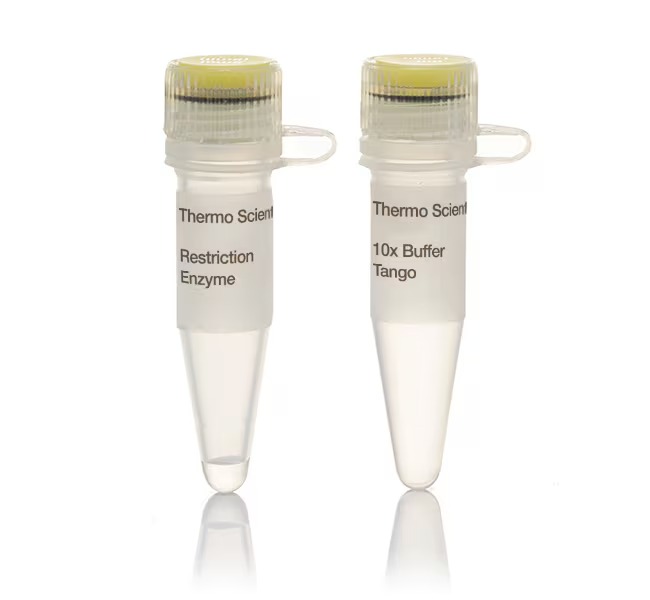
Thermo Scientific™ MspI (HpaII) Restriction Enzyme (10 U/µL)
Catalog No :
CAS Number :
Brand :
In Stock
Specifications:
| Application | Cloning, Transfection | ||
| Storage Temperature | -20°C | ||
| Product Type | Enzymes | Forms | Lyophilized |
| Product Brand | Thermo Fisher Scientific™ | ||
| Product Grade | Molecular Biology | ||
Thermo Scientific™ MspI (HpaII) is a high-quality restriction endonuclease used in molecular biology for DNA cleavage at specific recognition sequences. The enzyme recognizes the palindromic DNA sequence 5′-C^CGG-3′ and cleaves between the first and second cytosine residues, producing defined DNA fragments suitable for downstream genetic analysis and cloning workflows.
MspI is widely used in molecular cloning, restriction mapping, genotyping, and DNA methylation studies. It is an isoschizomer of HpaII, meaning both enzymes recognize the same DNA sequence but differ in their methylation sensitivity. Unlike HpaII, MspI can cleave DNA when the internal cytosine is methylated, making it particularly valuable for DNA methylation and epigenetics research.
The enzyme demonstrates optimal activity at 37 °C in Thermo Scientific™ 10X Tango buffer, which is included as part of the Thermo Scientific Five Buffer System. Reaction buffers contain premixed BSA, improving enzyme stability and binding potential contaminants that may be present in DNA preparations.
Thermo Scientific restriction enzymes are manufactured under stringent quality control standards, ensuring high reliability, reproducibility, and consistent performance in molecular biology laboratories.
For Research Use Only. Not for diagnostic procedures.
Key Features
- Recognizes the DNA sequence: 5′-C^CGG-3′
- High enzyme activity: 10 U/µL concentration
- Optimized for Thermo Scientific Five Buffer System
- Includes universal Tango buffer for double digestion
- Premixed BSA improves enzyme stability and performance
- Heat inactivation capability for easy reaction termination
- Strict quality control for consistent enzyme activity
Recognition Sequence and Cleavage Pattern
| DNA Sequence | Cleavage Site |
|---|---|
| 5′-C↓CGG-3′ | Cleavage between C and C |
| 3′-GGC↑C-5′ | Complementary strand cleavage |
This produces cohesive DNA fragments useful for cloning and restriction analysis.
Methylation Sensitivity
MspI and HpaII are isoschizomers recognizing the same sequence CCGG, but they differ in methylation behavior.
- MspI can cleave DNA when the internal cytosine is methylated
- HpaII cannot cleave when methylation occurs at specific cytosine positions
Therefore, using MspI together with HpaII enables researchers to study DNA methylation patterns and epigenetic modifications.
MspI is not sensitive to:
- Dam methylation
- Dcm methylation
- CpG methylation
Applications
Thermo Scientific MspI is widely used in:
- Molecular cloning
- Restriction site mapping
- Genotyping
- DNA methylation studies
- Southern blot analysis
- Restriction Fragment Length Polymorphism (RFLP) analysis
- Single nucleotide polymorphism (SNP) analysis
- Epigenetics research
Reaction Conditions
| Parameter | Specification |
|---|---|
| Enzyme Concentration | 10 U/µL |
| Optimal Temperature | 37 °C |
| Compatible Buffer | 10X Tango Buffer |
| Heat Inactivation | Yes |
| Type IIS Enzyme | No |
| Reaction System | Thermo Scientific Five Buffer System |
Ordering Information
| Catalog Number | Quantity |
|---|---|
| ER0541 | 3,000 units |
| ER0542 | 5 × 3,000 units |
Thermo Scientific™ MspI (HpaII) Restriction Enzyme is a reliable and high-performance molecular biology tool designed for precise DNA cleavage at CCGG recognition sites. Its compatibility with Thermo Scientific’s Five Buffer System, robust activity at 37 °C, and ability to cleave DNA containing certain methylated cytosines make it particularly valuable for cloning, restriction analysis, and DNA methylation studies. With stringent manufacturing quality control and optimized reaction buffers, MspI provides consistent results for genomics, epigenetics, and molecular biology research workflows.
- Pack Size: 3,000 units 5 x 3,000 units