










 Contact us
  My Experiments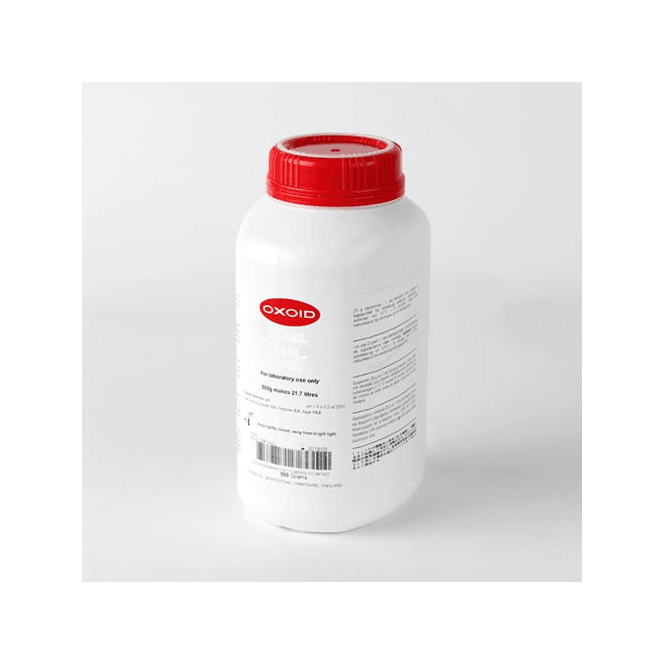
Mueller Hinton Broth is a widely recognized medium used in antimicrobial susceptibility testing, specifically for broth dilution Minimum Inhibitory Concentration (MIC) studies. It shares the same nutrient formulation as Mueller-Hinton Agar (CM0337), ensuring consistency in testing.
Key Features:
- Nutrient Composition:
- Beef infusion (300.0 g/L), casein hydrolysate (17.5 g/L), and starch (1.5 g/L).
- pH: 7.3 ± 0.1 @ 25°C.
- Cation Adjustment: Requires supplementation with Mg²⁺ (10–12.5 mg/L) and Ca²⁺ (20–25 mg/L) after sterilization for accurate MIC determination.
- Applications:
- Antimicrobial susceptibility testing.
- MIC studies for sulfonamides and trimethoprim (with lysed horse blood or thymidine phosphorylase).
- MIC determination for Helicobacter pylori in semi-solid agar format.
Preparation Instructions:
- Weigh: Dissolve 21.0 g of dehydrated medium in 1 L of distilled water.
- Sterilize: Autoclave at 121°C for 15 minutes.
- Adjust Cation Levels: Supplement with Mg²⁺ and Ca²⁺ as per CLSI guidelines.
- Store Prepared Medium: At 2–8°C.
Storage and Shelf Life:
- Dehydrated Medium: Store at 10–30°C, protected from moisture.
- Prepared Medium: Store at 2–8°C. Use before the expiry date.
Appearance:
- Dehydrated Medium: Straw-colored, free-flowing powder.
- Prepared Medium: Light straw to straw-colored solution.
Quality Control:
| Control | Organism | Expected Results |
|---|---|---|
| Positive | Escherichia coli ATCC® 25922 | Turbid growth |
| Pseudomonas aeruginosa ATCC® 27853 | Turbid growth | |
| Enterococcus faecalis ATCC® 29212 | Turbid growth | |
| Negative | Uninoculated medium | No change |
Special Considerations:
- Performance Monitoring: Regularly verify performance using standard quality control organisms. Adjust Mg²⁺ and Ca²⁺ volumes if expected MIC values deviate.
- Thymidine Content: Lower thymidine levels after adding lysed horse blood or thymidine phosphorylase for better MIC results.
- Compatibility: Suitable for aerobic bacteria.
Applications:
- Used in standardized antimicrobial susceptibility testing.
- MIC determination in clinical, food, and pharmaceutical microbiology.
- Evaluation of fastidious organisms like Helicobacter pylori in semi-solid agar formats.
References:
- NCCLS (2000) Methods for Dilution Antimicrobial Susceptibility Tests for Bacteria That Grow Aerobically.
- Thornsberry et al. (1977) Cumitech 6, American Society for Microbiology.
- Swenson & Thornsberry (1978) Curr. Microbiol.
- Kobayashi et al. (1997) J. Antimicrob. Chemother.
This broth is an essential tool for laboratories conducting reliable and consistent antimicrobial susceptibility testing.
No resources are currently available for this product.
Mueller Hinton Broth is a widely recognized medium used in antimicrobial susceptibility testing, specifically for broth dilution Minimum Inhibitory Concentration (MIC) studies. It shares the same nutrient formulation as Mueller-Hinton Agar (CM0337), ensuring consistency in testing.
Key Features:
- Nutrient Composition:
- Beef infusion (300.0 g/L), casein hydrolysate (17.5 g/L), and starch (1.5 g/L).
- pH: 7.3 ± 0.1 @ 25°C.
- Cation Adjustment: Requires supplementation with Mg²⁺ (10–12.5 mg/L) and Ca²⁺ (20–25 mg/L) after sterilization for accurate MIC determination.
- Applications:
- Antimicrobial susceptibility testing.
- MIC studies for sulfonamides and trimethoprim (with lysed horse blood or thymidine phosphorylase).
- MIC determination for Helicobacter pylori in semi-solid agar format.
Preparation Instructions:
- Weigh: Dissolve 21.0 g of dehydrated medium in 1 L of distilled water.
- Sterilize: Autoclave at 121°C for 15 minutes.
- Adjust Cation Levels: Supplement with Mg²⁺ and Ca²⁺ as per CLSI guidelines.
- Store Prepared Medium: At 2–8°C.
Storage and Shelf Life:
- Dehydrated Medium: Store at 10–30°C, protected from moisture.
- Prepared Medium: Store at 2–8°C. Use before the expiry date.
Appearance:
- Dehydrated Medium: Straw-colored, free-flowing powder.
- Prepared Medium: Light straw to straw-colored solution.
Quality Control:
| Control | Organism | Expected Results |
|---|---|---|
| Positive | Escherichia coli ATCC® 25922 | Turbid growth |
| Pseudomonas aeruginosa ATCC® 27853 | Turbid growth | |
| Enterococcus faecalis ATCC® 29212 | Turbid growth | |
| Negative | Uninoculated medium | No change |
Special Considerations:
- Performance Monitoring: Regularly verify performance using standard quality control organisms. Adjust Mg²⁺ and Ca²⁺ volumes if expected MIC values deviate.
- Thymidine Content: Lower thymidine levels after adding lysed horse blood or thymidine phosphorylase for better MIC results.
- Compatibility: Suitable for aerobic bacteria.
Applications:
- Used in standardized antimicrobial susceptibility testing.
- MIC determination in clinical, food, and pharmaceutical microbiology.
- Evaluation of fastidious organisms like Helicobacter pylori in semi-solid agar formats.
References:
- NCCLS (2000) Methods for Dilution Antimicrobial Susceptibility Tests for Bacteria That Grow Aerobically.
- Thornsberry et al. (1977) Cumitech 6, American Society for Microbiology.
- Swenson & Thornsberry (1978) Curr. Microbiol.
- Kobayashi et al. (1997) J. Antimicrob. Chemother.
This broth is an essential tool for laboratories conducting reliable and consistent antimicrobial susceptibility testing.
No resources are currently available for this product.