



 0
0
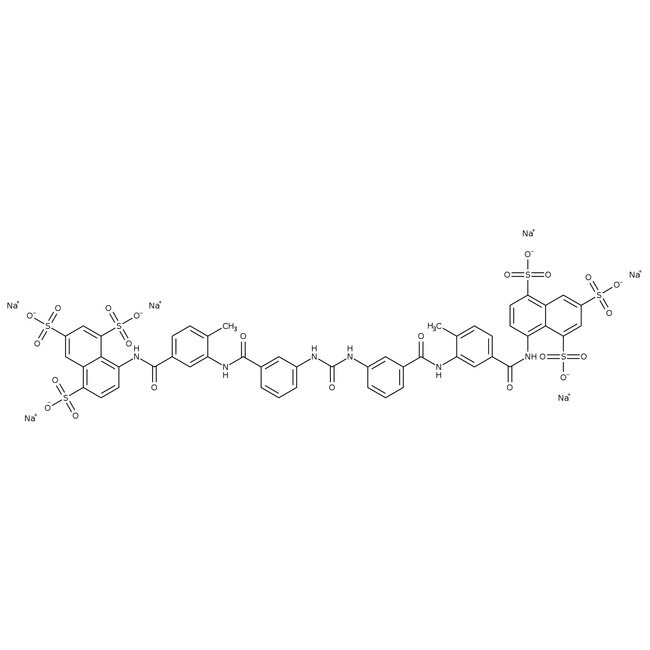
Thermo Scientific™ Suramin Hexasodium Salt, (HPLC) 98%, 500mg
Catalog No :
CAS Number :
Brand :
In Stock
Broad-Spectrum Growth Factor Inhibitor | G-Protein Uncoupler | Antiparasitic & Anticancer Agent
Specifications:
| Application | Life Science Applications | ||
| Storage Temperature | 2-8°C | ||
| Product Type | Biochemical Reagent | Forms | Solid |
| Product Brand | Thermo Fisher Scientific™, thermo Scientific | ||
| Product Grade | Molecular Biology | Formula | C₅₁H₃₄N₆Na₆O₂₃S₆ |
Thermo Scientific™ Suramin Hexasodium Salt (≥98%) is a polysulfonated naphthylurea derivative known for its broad-spectrum biological inhibition and signaling-modulation activities.
Originally developed as an antiparasitic compound, suramin is now widely used as a research tool in oncology, virology, and pharmacology for its ability to inhibit growth factors, block G-protein signaling, and suppress angiogenesis.
Suramin inhibits a wide range of targets, including SIRT1, SIRT5, PKC, FGF, VEGF, PDGF, EGF, and TGF-β, and also uncouples G-proteins from their receptors, affecting multiple cellular signaling pathways. It is also recognized for its anticancer, antiviral, and antiangiogenic properties in research contexts.
Key Features
- High Purity: ≥98% (HPLC verified).
- Broad-Spectrum Inhibitor: Blocks FGF, VEGF, PDGF, TGF-β, PKC, and topoisomerases I & II.
- G-Protein Uncoupler: Prevents receptor-mediated G-protein signaling.
- Metal-Independent Mechanism: Noncompetitive and reversible inhibition.
- Antiviral Activity: Reported to inhibit Zika virus, HIV, and other enveloped viruses.
- Anticancer Mechanism: Inhibits angiogenesis and DNA topoisomerase activity.
- Research Use Only (RUO): For laboratory applications; not for therapeutic use.
Chemical Identifiers
| Property | Value |
|---|---|
| Chemical Name (IUPAC) | Hexasodium 8-{4-methyl-3-[3-({[3-({2-methyl-5-[(4,6,8-trisulfonatonaphthalen-1-yl)carbamoyl]phenyl}carbamoyl)phenyl]carbamoyl}amino)benzamido]benzamido}naphthalene-1,3,5-trisulfonate |
| Synonyms | Suramin sodium, Suramin hexasodium, Antrypol, Naganinum, Naphuride sodium, Fourneau 309 |
| CAS Number | 129-46-4 |
| Molecular Formula | C₅₁H₃₄N₆Na₆O₂₃S₆ |
| Molecular Weight | 1429.15 g/mol |
| InChI Key | VAPNKLKDKUDFHK-UHFFFAOYSA-H |
| MDL Number | MFCD00210217 |
| EINECS Number | 204-949-3 |
| PubChem CID | 8514 |
Specifications
| Parameter | Specification |
|---|---|
| Purity | ≥98% |
| Form | Powder |
| Color | White |
| Solubility | Soluble in water and saline; sparingly soluble in ethanol |
| Storage Conditions | Keep cold, dry, and tightly closed |
| Stability | Protect from heat and moisture |
| Intended Use | Research Use Only (RUO) |
Applications
- Cancer Research: Studies of angiogenesis inhibition and DNA topoisomerase I/II blocking.
- Signal Transduction: Analysis of G-protein uncoupling and receptor desensitization mechanisms.
- Pharmacology: Investigating SIRT1/SIRT5 inhibition and cytokine signaling pathways.
- Virology: Evaluation of suramin’s antiviral effects on Zika and other enveloped viruses.
- Cell Biology: Studies on endothelial cell proliferation and migration inhibition.
- Nephrology and Fibrosis Models: Used to study anti-fibrotic effects in organ injury.
References
- Xiong, C. et al., “Delayed administration of suramin attenuates peritoneal fibrosis in rats.” BMC Nephrol. (2019) 20(1), 411.
- Tan, C.W. et al., “Polysulfonate suramin inhibits Zika virus infection.” Antiviral Res. (2017) 143, 186–194.
Safety & Handling
- Signal Word: Warning
-
Hazard Statements:
- H317 – May cause allergic skin reaction
-
Precautionary Statements:
- P280 – Wear protective gloves/protective clothing
- P302 + P352 – If on skin: Wash with plenty of soap and water
- P333 + P313 – If skin irritation or rash occurs: Get medical advice
- Classification: Skin Sensitization Cat. 1
The Thermo Scientific™ Suramin Hexasodium Salt (≥98%) is a broad-spectrum growth factor and signaling inhibitor with antiparasitic, anticancer, and antiviral applications.
Through its inhibition of multiple signaling pathways (including VEGF, PDGF, FGF, PKC, and SIRT enzymes) and its role as a G-protein uncoupler, suramin serves as a powerful biochemical tool for signal transduction, angiogenesis, and pharmacological research.