










 Contact us
  My Experiments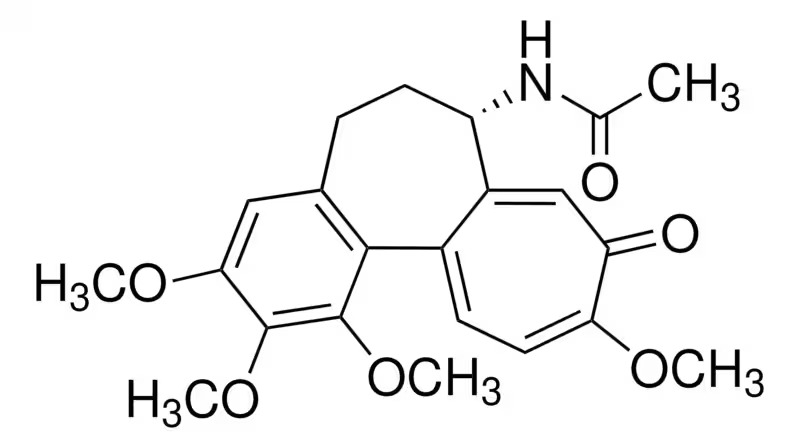
Colchicine is a potent alkaloid-derived secondary metabolite with well-documented antimitotic, anti-inflammatory, and cytotoxic properties. It exerts its primary biochemical effect by binding to tubulin, thereby inhibiting its polymerization and disrupting microtubule dynamics, making it a critical tool in cell cycle arrest, mitotic inhibition, and apoptosis studies.
This Thermo Scientific preparation of colchicine is supplied as a light yellow crystalline powder with ≥97% purity (determined by HPLC) and is suitable for biological, pharmacological, toxicological, and cellular research applications.
Available Pack Sizes
| Catalog Number | Pack Size | Container Type |
|---|---|---|
| 227125000 | 500 mg | Glass bottle for solids |
| 227120010 | 1 g | Glass bottle for solids |
| 227120050 | 5 g | Glass bottle |
| 227120250 | 25 g | Glass bottle |
Chemical & Physical Specifications
| Property | Specification |
|---|---|
| Purity (HPLC) | ≥96.0% (on anhydrous and solvent-free basis) |
| Appearance | Light yellow crystalline powder |
| Melting Point | 150–160 °C (decomposes) |
| Density | 1.32 g/cm³ (20 °C) |
| Water Content (K.F.) | ≤2% |
| Specific Optical Rotation | −240° to −250° (c = 1, alcohol, at 20 °C and 589 nm) |
| Infrared Spectrum | Conforms to reference standard |
Biochemical Actions & Mechanism
- Primary Action: Binds to tubulin, inhibiting its polymerization
- Disrupts: Microtubule assembly and dynamics
-
Cellular Effects:
- Inhibits mitosis
- Induces apoptosis
- Activates the JNK/SAPK pathway
- Suppresses cytokine secretion, fibroblast proliferation, and vesicle motility
-
Used to study:
- Leukocyte migration and diapedesis
- Lysosomal degranulation
- Collagen transport
Applications in Research
Colchicine has been used in:
- Genotoxicity assays: Sister-chromatid exchange (SCE) studies
- Antiviral/antibacterial research: Cytotoxic activity against pathogens
- Cytoskeletal studies: Microtubule depolymerization models
- Calcium signaling studies: Investigating Ca²⁺ transients in taxol-treated cells
- Anti-inflammatory and immunological research: Models of pericarditis, gout, familial Mediterranean fever, and Behçet’s disease
Storage and Handling
- Powder Stability: Stable at room temperature
- Light Sensitivity: Colchicine darkens upon light exposure; store protected from light
-
Solution Stability:
- Autoclavable and filter-sterilizable
- Stable ≥6 months in light-protected, sterilized solutions
- Stable in neutral and slightly alkaline solutions (pH ~8.1) when frozen
Thermo Scientific™ Colchicine (≥97%) is a high-purity, well-characterized small molecule essential for microtubule-targeted research, mitosis inhibition, and anti-inflammatory studies. With broad utility in cell biology, oncology, toxicology, and drug development, colchicine remains a foundational compound for investigating cytoskeletal function, inflammation, and cell cycle regulation. Its solid form is stable at room temperature and is packaged securely for laboratory use.
No resources are currently available for this product.
Colchicine is a potent alkaloid-derived secondary metabolite with well-documented antimitotic, anti-inflammatory, and cytotoxic properties. It exerts its primary biochemical effect by binding to tubulin, thereby inhibiting its polymerization and disrupting microtubule dynamics, making it a critical tool in cell cycle arrest, mitotic inhibition, and apoptosis studies.
This Thermo Scientific preparation of colchicine is supplied as a light yellow crystalline powder with ≥97% purity (determined by HPLC) and is suitable for biological, pharmacological, toxicological, and cellular research applications.
Available Pack Sizes
| Catalog Number | Pack Size | Container Type |
|---|---|---|
| 227125000 | 500 mg | Glass bottle for solids |
| 227120010 | 1 g | Glass bottle for solids |
| 227120050 | 5 g | Glass bottle |
| 227120250 | 25 g | Glass bottle |
Chemical & Physical Specifications
| Property | Specification |
|---|---|
| Purity (HPLC) | ≥96.0% (on anhydrous and solvent-free basis) |
| Appearance | Light yellow crystalline powder |
| Melting Point | 150–160 °C (decomposes) |
| Density | 1.32 g/cm³ (20 °C) |
| Water Content (K.F.) | ≤2% |
| Specific Optical Rotation | −240° to −250° (c = 1, alcohol, at 20 °C and 589 nm) |
| Infrared Spectrum | Conforms to reference standard |
Biochemical Actions & Mechanism
- Primary Action: Binds to tubulin, inhibiting its polymerization
- Disrupts: Microtubule assembly and dynamics
-
Cellular Effects:
- Inhibits mitosis
- Induces apoptosis
- Activates the JNK/SAPK pathway
- Suppresses cytokine secretion, fibroblast proliferation, and vesicle motility
-
Used to study:
- Leukocyte migration and diapedesis
- Lysosomal degranulation
- Collagen transport
Applications in Research
Colchicine has been used in:
- Genotoxicity assays: Sister-chromatid exchange (SCE) studies
- Antiviral/antibacterial research: Cytotoxic activity against pathogens
- Cytoskeletal studies: Microtubule depolymerization models
- Calcium signaling studies: Investigating Ca²⁺ transients in taxol-treated cells
- Anti-inflammatory and immunological research: Models of pericarditis, gout, familial Mediterranean fever, and Behçet’s disease
Storage and Handling
- Powder Stability: Stable at room temperature
- Light Sensitivity: Colchicine darkens upon light exposure; store protected from light
-
Solution Stability:
- Autoclavable and filter-sterilizable
- Stable ≥6 months in light-protected, sterilized solutions
- Stable in neutral and slightly alkaline solutions (pH ~8.1) when frozen
Thermo Scientific™ Colchicine (≥97%) is a high-purity, well-characterized small molecule essential for microtubule-targeted research, mitosis inhibition, and anti-inflammatory studies. With broad utility in cell biology, oncology, toxicology, and drug development, colchicine remains a foundational compound for investigating cytoskeletal function, inflammation, and cell cycle regulation. Its solid form is stable at room temperature and is packaged securely for laboratory use.
No resources are currently available for this product.
![[00450651] Invitrogen™ eBioscience™ Brefeldin A Solution (1000X)](/web/image/product.product/34449/image_512/%5B00450651%5D%20Invitrogen%E2%84%A2%20eBioscience%E2%84%A2%20Brefeldin%20A%20Solution%20%281000X%29?unique=96c5da2)
![[276720010] Thermo Scientific™ (+)-Camptothecin, 98% (1g)](/web/image/product.product/45590/image_512/%5B276720010%5D%20Thermo%20Scientific%E2%84%A2%20%28%2B%29-Camptothecin%2C%2098%25%20%281g%29?unique=96c5da2)
![[J62340.MA] Thermo Scientific™ Brefeldin A, 98% (10mg)](/web/image/product.product/45586/image_512/%5BJ62340.MA%5D%20Thermo%20Scientific%E2%84%A2%20Brefeldin%20A%2C%2098%25%20%2810mg%29?unique=96c5da2)
![[J62523.03] Thermo Scientific™ Camptothecin, (HPLC) >90% (1g)](/web/image/product.product/45592/image_512/%5BJ62523.03%5D%20Thermo%20Scientific%E2%84%A2%20Camptothecin%2C%20%28HPLC%29%20%3E90%25%20%281g%29?unique=96c5da2)
Spécifications
| Pack Size | 1g, 5g, 25g, 500mg |